



How certification is advancing tandem solar cells | Hanwha
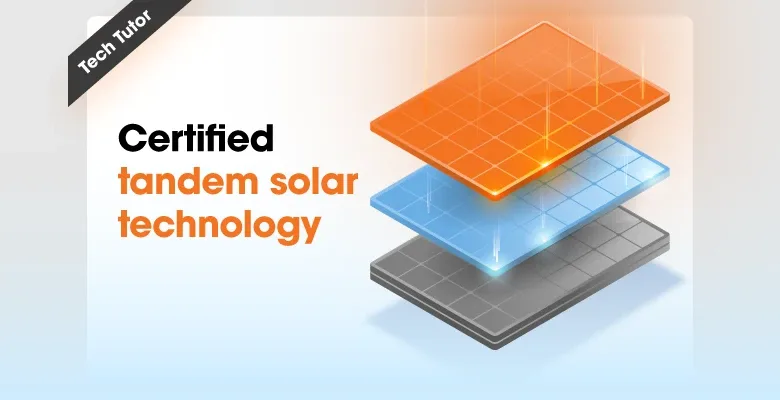
Enhancing energy capture from sunlight has long been a primary objective within the solar industry. Perovskite-silicon tandem solar cells present a significant advancement, potentially converting a larger proportion of sunlight into usable energy compared to traditional silicon solar cells. Perovskite, characterized by its photoactive crystal structure, is capable of absorbing short-wavelength light. This is achieved through a solution process that allows it to be fabricated into a thin film, positioning it as a scalable and cost-effective solar technology. Furthermore, this technology utilizes fewer materials, demonstrating efficient light absorption while being both lightweight and flexible.
However, before this cutting-edge solar technology can be commercially released and implemented on a large scale, it must first prove its capability to function safely, reliably, and consistently in real-world scenarios.
The achievement of independent certification serves as a crucial milestone in this process. Recently, Qcells has achieved the distinction of being the first company to secure independent certification for its tandem solar modules. This certification affirms that their products satisfy internationally recognized benchmarks for safety, reliability, and performance, moving the technology closer to market readiness.
This article delves into the workings of perovskite-silicon tandem solar cells, the significance of this certification, and its implications for the future of solar energy.