


As the Marine Corps gears up for distributed operations in increasingly contested environments, it is imperative to ensure the movement of critical supplies without risking the safety of pilots. The Aerial Logistics Connector (ALC) program stands poised to address this need, having recently advanced in its efforts to demonstrate the future of contested logistics.
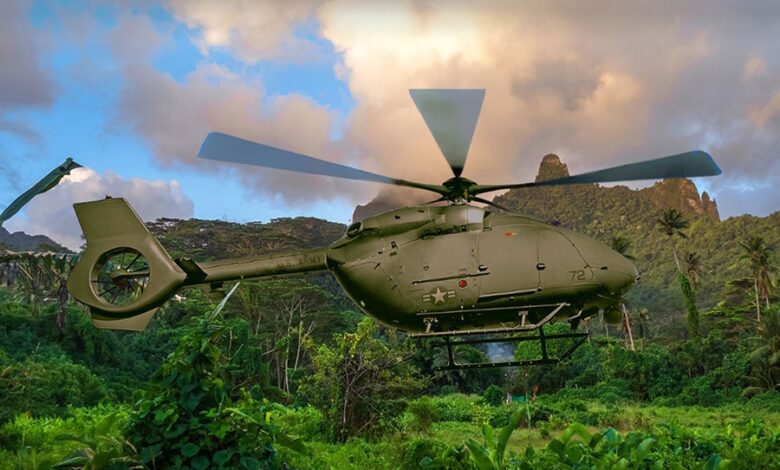
In collaboration with L3Harris Technologies, Shield AI, and Parry Labs, Airbus U.S. Space & Defense has successfully conducted the fourth autonomous flight test of the MQ-72C Lakota Connector. Notably, this test marked the first occasion where all four partners’ technologies functioned in unison aboard an H-145 aircraft, autonomously navigating obstacles and executing a safe landing in conditions that replicate real-world scenarios.
Advancing from Prototype to Operational Benefit
The MQ-72C, an autonomous variant of the UH-72 Lakota platform, amalgamates a proven airframe with advanced autonomy and an open architecture, offering a low-risk, cost-effective approach to unmanned logistics at scale. Rather than a theoretical concept, this initiative embodies rapid prototyping grounded in operational experience. Featuring an active U.S. production line, the system is poised for evolution, integrating new capabilities swiftly while delivering value across the joint force.
Utilizing a Modular Open Systems Approach (MOSA), the partnering team facilitates the rapid assimilation of innovative technologies—from autonomy software to future payloads, including signals intelligence and launched effects. This flexibility ensures that the platform can adapt promptly to the shifting threat landscape, providing the Marine Corps with enhanced capability, expedited deployment, and logistical support in theaters where conventional supply chains face challenges.
Establishing the Digital Framework: The Backbone of ALC
The success of autonomy hinges on more than just software—it necessitates a mission system capable of connecting, integrating, and scaling various components. Here, L3Harris plays a crucial role as the lead systems integrator, delivering the digital backbone that transforms disparate technologies into a cohesive, combat-ready system of systems. By employing the MOSA framework, L3Harris enables smooth integration of third-party and commercial technologies, which accelerates development timelines while mitigating risk.
With over sixty years of expertise in aircraft integration, electronic warfare, communications, and network-enabled systems, L3Harris possesses the necessary know-how to transition from prototype to operational readiness. Their platform-agnostic integration model ensures that new sensors, payloads, and capabilities can be swiftly incorporated without the necessity for extensive system redesigns. This results in a logistics connector built for ongoing evolution.
In a future combat landscape characterized by distance, denial, and disruption, adaptability will be crucial for success. The Marine Corps requires a capability that can keep pace with the demands of modern warfare, and the MQ-72C Lakota Connector is continually proving its potential to meet this challenge.
Source: L3Harris (2026-04-24)