


From Payload to Platform: Autonomous ISR Where It Actually Matters
At 0200, 80 nautical miles offshore, the ocean appears desolate. Yet beneath the surface, a fast-moving vessel with a low profile and minimal lighting navigates the waves. The rising sea state deteriorates visibility. A reconnaissance aircraft is racing through the skies, while the sensor operator juggles communications traffic, airspace deconfliction, and multiple directives from higher command. In today’s complex environment, ISR missions hinge entirely on the success of early detection.
For decades, the defining factor of ISR missions has been the performance of electro-optical/infrared (EO/IR) systems: sharper imagery, extended range, and enhanced stabilization. However, the operational landscape has evolved dramatically. Sensors now require not just the capability to observe from a distance but the agility to identify quickly. The vessel’s small size, erratic movement, and tendency to blend into maritime clutter can lead to its complete loss if detection fails at an early stage.
The Operator Bottleneck

Experienced sensor operators face immediate challenges that are intrinsically human. Missions demand hours of manual scanning, managing numerous feeds while balancing competing priorities. It’s no surprise that fatigue sets in long before the mission concludes.
Despite having access to advanced EO/IR systems, the operational process remains largely manual: operators search, cue, track, and confirm targets. As mission scales increase, the number of sensors utilized and the compressed timelines can render workloads unbearable for limited crews. The real danger lies not in the sensors’ inability to see a target but rather in the risk that no one will spot it in time.
Many so-called “AI-enabled” ISR solutions tend to falter here, as they primarily process, enhance, and analyze data after the fact, failing to tackle the root issue: who is conducting the search?
Shifting the Burden: Autonomy at the Sensor Edge
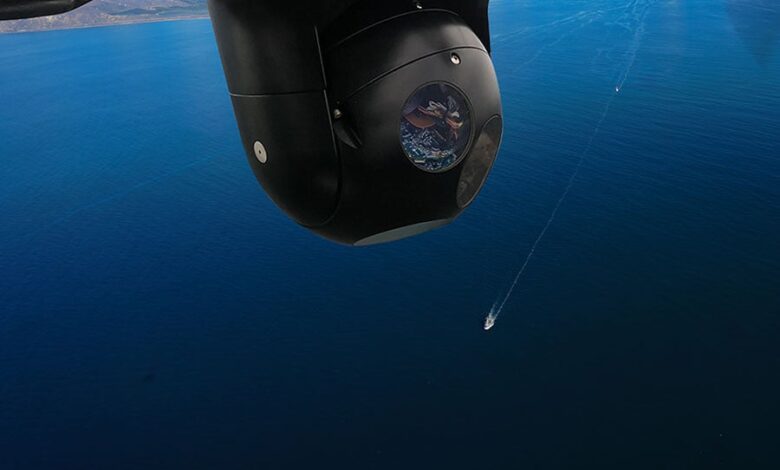
The integration of L3Harris’ WESCAM MX-Series EO/IR systems with Overwatch Imaging’s Automated Sensor Operator (ASO) transforms this narrative. Rather than relying on operators to locate and cue targets, the sensor itself continuously analyzes the environment. It scans, detects, classifies, and initiates tracks in real time, right where collection occurs.

In this setup, vessels are identified while still outside of the operator’s immediate focus. A track is developed early, before the scenario grows more complex or the target becomes lost in sea clutter. The advantages are immediate for operators, with the sensor functioning as a tireless second set of eyes.
This technology elevates the autonomy of state-of-the-art platforms considerably.
As one operator aptly stated, “If you don’t automate the sensor’s ability to locate high-value targets, then the platform isn’t genuinely autonomous. Teams need to consider—while your platform may function autonomously, does your sensor?”
Not All “AI at the Edge” Is Equal
The market presents numerous EO/IR and AI combinations, which often fall into three distinct categories:
Post-Mission Analytics
High-quality imagery is gathered, downlinked, and processed later. While this can be invaluable for intelligence purposes, it is of little use for time-sensitive missions where every second counts.
Ground-Dependent AI
These solutions rely on off-board algorithms and require consistent, high-bandwidth data links. They function effectively in permissive conditions but struggle under degraded or contested communications.
Narrow, Pre-Configured Detection Models
Such solutions are customized for specific targets or environments and often necessitate reconfiguration or retraining to adapt to new mission parameters—imposing restrictions on dynamic operations.
The distinguishing factor with L3Harris’ WESCAM MX-Series and Overwatch Imaging’s ASO lies within their architecture. Processing occurs onboard, rather than downstream, ensuring continuous detection that isn’t contingent on triggers. They offer adaptable mission capabilities rather than fixed ones. This represents the next step in AI development, fully integrated into the sensor instead of supplementary. ASO scrutinizes every pixel within the sensor’s field of view in real time, efficiently scanning large areas at a consistency that no human operator can endure over extended missions. Even under deteriorating conditions or when operator focus shifts, the system retains awareness of the vessel.
Working the Mission, Not the Sensor
In a standard multi-sensor aircraft, the crew’s capacity dictates how sensors are utilized. One is actively tasked while others are sidelined—not due to a lack of capability, but due to the limited ability of crew members to manage multiple systems effectively.

With ASO-enabled WESCAM MX-Series systems, this restriction is eliminated. Multiple sensors can conduct simultaneous, autonomous search operations, each independently tracking and feeding the operator prioritized insights. This transformation reshapes mission execution. Units can broaden their effective coverage area while enhancing detection probabilities with systematic and persistent searches, all without necessitating additional sorties. When engagement is required, transition speed between autonomous and manual control is significantly improved.
While one sensor keeps track of a vessel, another continues scanning the larger area for potential additional contacts or activities. Operators are no longer forced into choosing between focus and protection.
Whether from the cockpit or mission console, the distinction is profound: Instead of managing sensors, operators oversee the mission. Rather than scanning empty expanses, they are making calls based on validated detections. Instead of reacting too late, they can act in a timely manner. This exemplifies the WESCAM MX-Series ethos: See First. Act First.
Decision Advantage in Denied Environments
In contested settings, bandwidth cannot be taken for granted. Factors like jamming, latency, or network saturation may disrupt the flow of ISR data to ground stations, many of which depend on offboard processing.
This introduces a level of risk, where a compromised link leads to a loss in the ability to confirm, classify, or distribute the vessel’s location necessary for prompt action.
WESCAM MX-Series sensors with ASO eliminate this reliance. Local detection, classification, and tracking occur onboard the platform, ensuring that actionable intelligence can be produced regardless of connectivity. Even in communications-denied scenarios, the operator maintains full situational awareness of the sensor’s field of view. The timeline from sensor data to decision-maker is effectively collapsed.
Mission Agility Without Reset

Real-world missions rarely adhere to neat definitions. A maritime surveillance task can swiftly transition into land tracking. A border patrol operation might evolve into search and rescue efforts. A wildfire monitoring mission may unexpectedly require infrastructure assessment.
Many systems introduce complications during these transitions, leading to the need for new configurations, workflows, and resultant delays. With WESCAM MX-Series and ASO, those complications vanish. The same unit, the same sortie, and the same workflow can seamlessly adjust in response to real-time mission requirements, with no requirement for costly reconfiguration, downtime, or loss of coverage.
The system tracking maritime targets can be reassigned instantly as situations change, all without interrupting ongoing detection or losing critical context.
Proven in the Conditions That Matter
The advantages of sensor-level autonomy become especially pronounced when operational pressure mounts. In maritime environments, ASO-enabled WESCAM MX-Series systems have proven reliable in detection performance across various operational envelopes, operating from low levels to altitudes reaching 30,000 feet, at platform speeds exceeding 200 knots, and ranges extending beyond 130 nautical miles.
Remarkably, as one classified operator remarked:
“Overwatch Imaging’s ASO proved to be an exceptionally capable maritime surveillance tool, consistently detecting vessels from 7 meters to over 200 meters. Its ability to rapidly identify targets and provide actionable awareness while minimizing operator workload showcases both its effectiveness and efficiency.”
The impacts for operators are tangible, resulting in earlier detection of low-signature targets, sustained tracking without the need for constant manual input, and reduced cognitive demands throughout lengthy missions. The vessel is found early, tracked consistently, and never misplaced.
Extending Capability Without Replacing Fleets
Perhaps the most significant advantage is the manner in which this capability is delivered. By means of software integration, existing WESCAM MX-Series sensors can incorporate ASO technology, converting current fleets into autonomy-enabled ISR assets without the need for new airframes, sensors, or major overhauls. This allows operators to enhance capabilities now while safeguarding long-term investments in platforms and systems.
The New Role of the Sensor

The transition from payload to platform is not merely theoretical; it is operationally real. An EO/IR system now functions actively as a contributor to mission execution—constantly searching, detecting, tracking, and informing—without imposing additional burdens on operators.
The vessel is consistently detected early, tracked amid challenging conditions, and regarded as a known contact despite competing demands and deteriorated visibility. Operators are empowered, and missions stay on track.
In contemporary ISR, the upper hand is not merely a function of the longest flight times or the furthest sightlines from sensors. Instead, it lies with the team that locates first—and acts swiftly.
With WESCAM MX-Series and Overwatch Imaging’s ASO, that advantage begins right at the sensor.
Source: L3Harris (2026-05-21)