

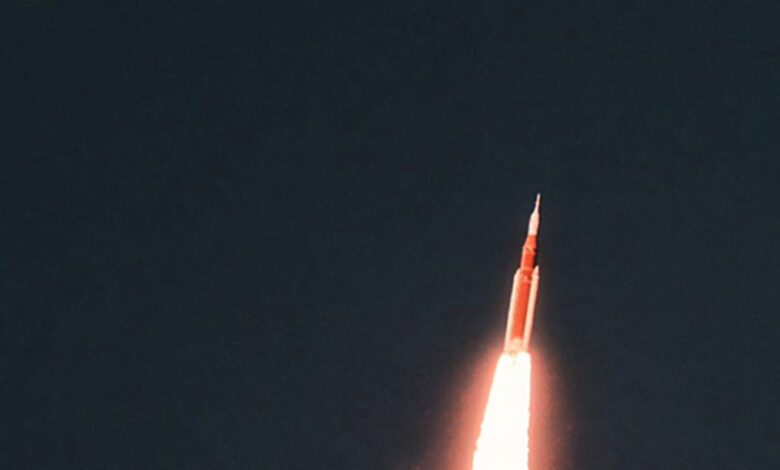
As NASA’s Artemis II crew vehicle reentered Earth’s atmosphere, every detail hinged on meticulous execution. The mission’s trajectory was fixed and the timeline unforgiving, demanding precise planning and execution for critical events like heat-soaked reentry, parachute deployments, and splashdown.
To support these crucial moments, L3Harris provided specialized airborne imaging assistance utilizing WESCAM MX-Series electro optical/infrared systems, bolstered by a highly skilled team of pilots and operators. Their combined expertise resulted in real-time and post-mission imagery that is imperative for enhancing future mission safety, engineering assessments, and astronaut recovery operations.
Meticulous Mission Planning
Nasa typically issues planned mission attempts approximately one month in advance, marking the initiation of L3Harris’ planning cycle. This phase quickly transitions into a daily operational rhythm characterized by continuous monitoring of weather trends, coordination of aircraft logistics, and crew movements, as well as evaluations of sensor integration requirements to conform with NASA’s operational needs.
As the mission closing in around one to one and a half weeks prior to the first recovery attempt, the focus sharpens. Trajectory data, formation specifics, and target area maps start coming in. Concurrently, coordination meetings commence with NASA and other involved agencies and partners, centering on airborne and surface asset alignment, altitude deconfliction, radio communication definitions, and real-time synchronization of timelines.
Utilizing this information, the flight team crafts detailed plans for entering and exiting the mission area while establishing inbound flight tracks that meet NASA’s imaging specifications while also respecting airspace constraints. By the time the aircraft takes off, the outcome has already been engineered through rigurous validation and collaboration across teams.
Technical Precision and Execution
The technical demands for recovery imagery are both high and specific. The aircraft maintains a circular exclusion zone about five kilometers from the planned splashdown site. The inbound flight track is intentionally designed perpendicular to the capsule’s return path, a geometry that maximizes sensor angles during vital descent phases.
Arriving approximately two days before the mission, the aircraft undergoes NASA-specific equipment installation and full integration. A dedicated test flight then validates sensor functionality and confirms the datalink used to transmit live imagery from the WESCAM MX-Series system. This is a critical step, as the imagery must reach decision-makers in real time to be effective.
On the mission day, the crew departs early to position themselves approximately 45 minutes ahead of splashdown. This time buffer allows for adjustments due to prevailing winds, necessitating real-time adaptations to headings and airspeeds as well as continual alignment of planned geometries.
During the capsule’s descent, the Medium Wave Infrared (MWIR) mode typically becomes the principal acquisition mode. By tracking the vehicle’s heat signature, the sensor operator continuously adjusts zoom, focus, and gain to ensure image clarity throughout descent and parachute deployment.
Challenges of the Final Countdown
Execution determines the success of all prior preparations.
As the mission approaches, around 15 minutes before splashdown, the pace escalates. Pilots must maintain the aircraft precisely in position, while sensor operators concentrate on a narrow azimuth window, anticipating the capsule’s appearance at a location dictated strictly by physics.
Upon spotting the capsule, the urgency intensifies. There are only fleeting moments to capture crucial imagery, especially during the drogue parachute deployment and the inflation of the main parachute, events that unfold rapidly and cannot be replicated.
Compounding the challenge is the lack of recovery from error. The capsule adheres to its timeline autonomously, regardless of any aerial conditions. If the aircraft is mispositioned, if geometry is off, or if sensor performance falters, the opportunity for capturing key data vanishes. This reality imposes immense pressure on both pilots and sensor operators as every second counts.
After splashdown, the mission continues, with the aircraft remaining on site to provide live footage of capsule stabilization, crew recovery, and parachute assembly retrieval. This imagery proves vital for post-mission analysis, where engineers review deployment performance and examines even minor anomalies that could impact future missions.
A Unified Team for a Singular Outcome
The success of these missions hinges on mutual trust among pilots and sensor operators, planners and aircrew, as well as between L3Harris teams and their NASA counterparts. Stable flight ensures optimal performance from WESCAM MX-Series systems, while clear, ongoing communication allows crews to adapt to evolving conditions instantaneously.
Weather fluctuations, atmospheric distortions, airspace limitations, and shifting timelines are ever-present variables. L3Harris crews are trained for real-time adaptation, modifying aircraft positioning and sensor configurations while remaining focused on mission objectives.
The Significance of Artemis II Imagery
The imagery captured through WESCAM MX-Series systems transcends mere documentation; it serves as a crucial tool for engineering validation, anomaly detection, and fortifying mission safety and reliability. In the case of Artemis II, the imagery played a pivotal role in establishing confidence in parachute performance and recovery procedures, systems that astronauts rely on in the critical moments of their mission.
From providing support during launch to managing the intricacies of splashdown and recovery, L3Harris’ involvement in Artemis II exemplifies the precision, discipline, and accountability essential for facilitating the nation’s most significant space missions. With only one chance to achieve success, the fusion of preparation and performance is paramount. L3Harris stands ready for future spaceflight endeavors.
Source: L3Harris (2026-06-22)