

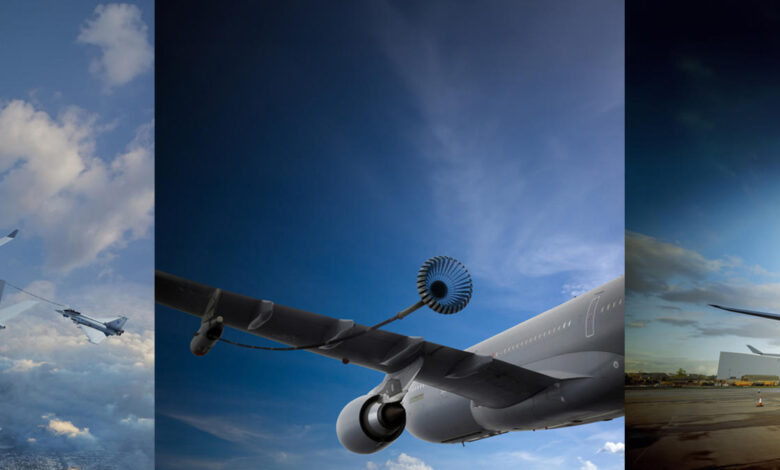
From concept to a cornerstone of aviation, air-to-air refuelling has reached a significant milestone in its 100-year journey, yet the potential for advancement remains vast.
In 2023, we celebrated a century since the inaugural air-to-air refuelling mission, executed by two US DH-4B biplanes. Since this landmark event, air-to-air refuelling has evolved into a vital infrastructure of modern military aviation, enhancing mission range and operational effectiveness.
Leading the contemporary aerial refuelling landscape is the A330 MRTT, which has been extensively deployed by air forces globally, amassing thousands of flight hours in both military operations and humanitarian efforts. The Royal Air Force (RAF) stands out with its fleet of 14 A330 MRTTs, known in the UK as Voyager, actively pushing the limits of air-to-air refuelling a century after its historic inception.
A Record-Breaking Journey
As part of the Exercise Mobility Guardian 23 launch, the RAF undertook a remarkable flight challenge. On July 3, 2023, an A400M Atlas aircraft took off from RAF Brize Norton for a non-stop flight to the Pacific island of Guam. Covering 7,000 miles in just 22 hours, this mission marks the longest flight accomplished by a propeller-driven aircraft.
Air Commodore Anthony John Lyle, RAF’s Air Mobility Force Commander, highlighted the mission as an exemplary demonstration of the RAF’s air power projection capabilities, confirming its ability to transport aircraft, crews, and essential equipment across the globe promptly and effectively.
The mission was made possible by the Voyager, which facilitated three air-to-air refuelling operations over the Atlantic, Alaska, and the Pacific. The first of these refuelling maneuvers was conducted by a Voyager from the 10/101 Squadron operating from the UK, while a second Voyager from the Eielson Air Force Base in Alaska managed the remaining refuels.
Flight Lieutenant Andy York from Voyager Force Training Flight expressed pride in the operation, emphasizing the extensive planning involved: “This exercise allowed us to validate long-range strategic air-to-air refuelling capabilities conducted from forward-operating bases.”
Pioneering Sustainable Aviation
The RAF is also dedicated to diminishing its carbon footprint and achieving Net Zero emissions by 2040. Central to this initiative is the transition to Sustainable Aviation Fuel (SAF), derived from waste resources like used cooking oil, with the potential to lower lifecycle carbon emissions by up to 80% compared to traditional fuels.
The Voyager has been instrumental in this transition, becoming the first in-service military aircraft globally to fly with 100% SAF in November 2022, marking a historic moment as it was also the first time any aircraft utilized 100% SAF within UK airspace.
Jesus Ruiz, Experimental test pilot and Captain of the flight, affirmed the seamless nature of the SAF operation: “From the crew perspective, the SAF operation was ‘transparent’ – we observed no operational differences.”
The RAF has undertaken several SAF trials since, including a blend of SAF and conventional aviation fuel used in a Eurofighter Typhoon during an in-flight refuelling exercise from a Voyager aircraft. In April 2023, the Voyager conducted another air-to-air refuelling mission utilizing 43% SAF, successfully refueling four Eurofighter Typhoon jets while flying from RAF Brize Norton over the North Sea.
Looking Ahead After a Century
Despite now being a century old, air-to-air refuelling remains a dynamic field, rich with advancements poised to redefine its future.
Notably, the Airbus A330 MRTT has achieved a major feat by becoming the first tanker certified for automatic air-to-air refuelling operations (A3R) in daylight, with night-time certification expected in 2024. This breakthrough is anticipated to lighten the workload for operators while enhancing safety and fuel transfer rates in real-world conditions.
Furthermore, a partnership between Airbus Defence and Space and Airbus UpNext is driving the development of Auto’Mate, a demonstrator aimed at achieving Autonomous Assets Air-to-Air Refuelling (A4R) and Autonomous Formation Flight (AF2). This innovation seeks to fully automate the air-to-air refuelling process, enabling tankers to autonomously guide receiving aircraft into position, conduct fuel transfers, and execute safe separation maneuvers. Such technology would pave the way for aerial refuelling operations involving uncrewed combat vehicles like drones.
Air-to-air refuelling has come an immense distance over the past century, and the forthcoming advancements promise an equally exhilarating future.
Source: Airbus Defence and Space (2023-12-18)