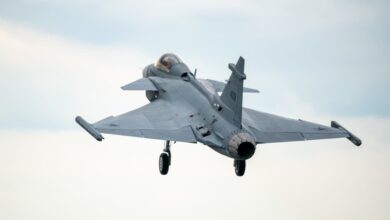


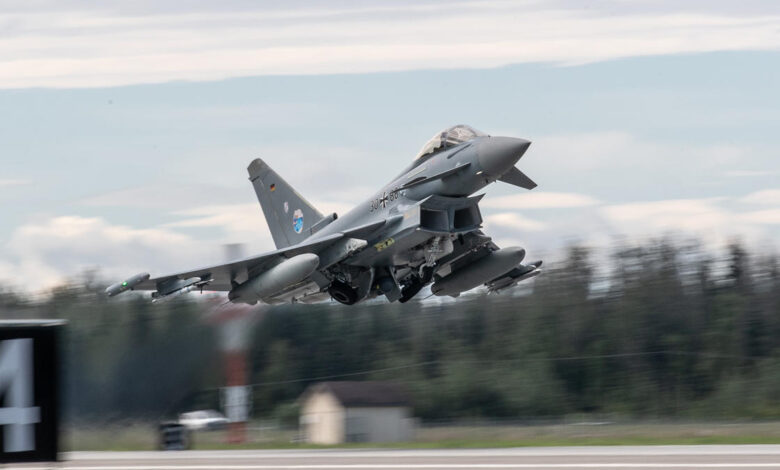
In the midst of the Arctic Defender exercise, René and Sebastian undoubtedly enjoyed one of the best views at Eielson Air Force Base. A mere 200 meters and a window pane separated them from the dramatic scene outside, as American, German, French, and Spanish fighter jets ascended into the Alaskan sky, practicing for a potential attack on NATO territory. At certain moments, as many as 60 military aircraft took to the air simultaneously.
Held from July 8 to 18, 2024, in Fairbanks, Alaska, Arctic Defender marked the first phase of one of the largest air exercises ever conducted. Pacific Skies aims to enhance the operational capabilities of NATO allies and to assert their commitment to a rules-based international order during conflicts. Eight German Eurofighters from Tactical Air Wing 31 “Boelcke” were integral to this exercise, led by the German Air Force, where René and Sebastian played crucial roles.
Supporting Eurofighter Pilots in Their Missions
As a Field Service Representative of the System Support Center Eurofighter (SSC EF), René is part of a civil-military partnership between Airbus, the manufacturer of the German Eurofighter, and the German Air Force. The SSC EF has been a key contributor to the operational readiness of the Eurofighter fleet for the past 21 years. Sebastian serves as a captain and system engineer with Tactical Air Wing 31, collaborating to ensure the pilots can effectively execute their missions.
“We’re on a joint mission to enable our pilots to execute their missions as planned,” says the duo, who, despite differing employers, work closely together to support the Eurofighter.
Attached to Tactical Air Wing 31 “Boelcke,” René supports the wing at its Nörvenich base and during deployments such as Arctic Defender. He analyzes pilot feedback and weapon system data to troubleshoot issues related to the Eurofighter’s radar and defensive aids sub-system, both of which are critical to the aircraft’s functionality.
In turn, Sebastian’s responsibilities include aiding subsystem specialists and performing “HLBA action” on the aircraft, which involves connecting a laptop to monitor signals on the Eurofighter’s bus system. “We all collaborate with the Ground Support System to maintain the database and address any failures that arise,” Sebastian notes.
Throughout the exercise, René and Sebastian also maintained communication with colleagues at the SSC EF in Manching, Germany, which provides technical and logistical support for the Eurofighter fleet. This robust support network was invaluable during Arctic Defender.
Collaboration with a View
René and Sebastian shared a prime office location at Eielson Air Force Base, allowing them to keep an eye on the unfolding exercises. “This is where we spent most of our working hours unless we were outside with the aircraft,” René explains. They analyzed mission and aircraft data transmitted from the Eurofighter’s onboard systems, checking for operational readiness.
“What makes our collaboration work is truly a symbiosis,” Sebastian elaborates. “We learn from each other and share experiences.” René echoes this sentiment, expressing his close relationship with Tactical Air Wing 31: “I feel like I’m part of it.”
Thanks to meticulous preparation before Arctic Defender, all German Eurofighters arrived safely at Eielson after a journey from Europe that included air-to-air refueling by Airbus A330 MRTT tankers and a stop in Goose Bay, Canada. Despite initial hurdles, all aircraft were successfully utilized in the exercise, a testament to teamwork and preparation.
Looking Ahead: Japan and Australia
“I am proud to be part of this exercise and help keep the fleet on track,” René states. Sebastian shares the same pride, emphasizing the importance of their efforts for technical and logistical mission success. The collaborative environment during the exercise streamlined operations, setting the stage for future endeavors, including upcoming exercises in Japan and Australia as part of the Pacific Skies initiative.
Source: Airbus Defence and Space (2024-07-18)