

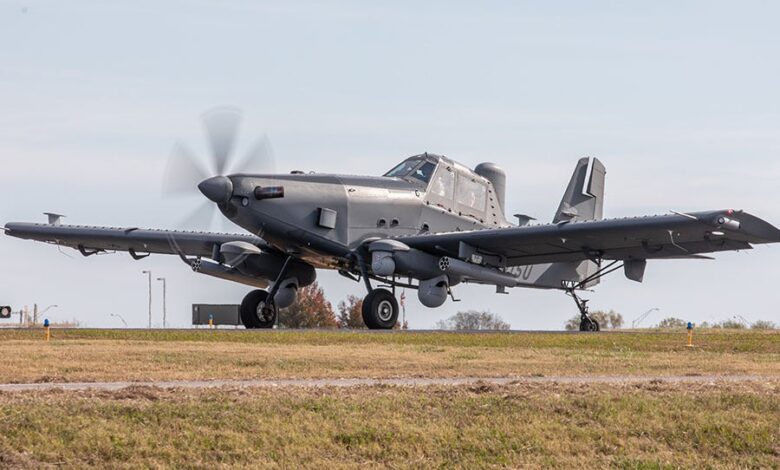
Maximizing Fighter Capacity with L3Harris’ SKY RAIDER II INTERNATIONAL
The increasing demand for persistent intelligence, surveillance, and reconnaissance (ISR) armed overwatch across fourth- and fifth-generation fighter fleets has positioned L3Harris’ SKY RAIDER II INTERNATIONAL™ as a vital asset. This platform enhances fleet effectiveness by minimizing operational costs, addressing mission gaps, and maintaining fighter readiness.
Lowering Costs Without Sacrificing Capability
Transferring routine missions from fighters to the SKY RAIDER II INTERNATIONAL can yield savings for fighter fleets ranging from $20,000 to $40,000 per flight hour. This cost efficiency allows commanders to increase flight operations while reducing expenditure. Notably, the aircraft’s operational requirements are minimal, needing only two mechanics, and pilots can be dual-qualified, facilitating easy integration into existing fighter fleets.
Closing Mission Gaps
The SKY RAIDER II INTERNATIONAL effectively fills the operational gap between unmanned aerial vehicles (UAVs) and fighter jets when the latter’s capabilities are unwarranted. This ISR and light strike aircraft offers greater airpower than a UAV, enabling human decision authority and a consistent armed presence for swift responses without taxing fighter resources. By adopting a mixed-fleet strategy, fighter operators can concentrate on air defense missions that necessitate rapid response and advanced capabilities, thus preserving flight hours and prolonging aircraft life span.
Preserving Fighter Readiness
Every hour a fighter is engaged in routine missions detracts from its availability for critical deterrence or defense operations. The armed ISR capabilities of the SKY RAIDER II INTERNATIONAL provide continuous presence for missions, such as counter-smuggling and precision strikes on small targets, which do not demand fighter capabilities. As the aircraft absorbs these non-fighter tasks, it alleviates airframe wear, reduces engine and landing cycle demands, minimizes avionics erosion, and lowers overall maintenance needs across the fighter fleet.
The L3Harris Advantage
Designed for operation in remote locations with unimproved runways, the SKY RAIDER II INTERNATIONAL boasts up to eight hours of endurance and accommodates 6,000 pounds of payload across 11 hard points, enabling prolonged missions. Its integrated cockpit merges flight and mission systems into a single display, which lessens operator workload and fatigue while enhancing decision-making efficiency. Furthermore, the platform’s modular design allows for seamless integration with L3Harris technologies, including the Red Wolf™ for long-range precision strike and the Green Wolf electronic warfare capabilities that extend loiter time to five hours with a combat radius of 250 nautical miles. Also, L3Harris’ WESCAM® MX®-Series electro-optical/infrared sensor systems enhance surveillance, target acquisition, and designation capabilities in medium-to-high altitude combat scenarios.
Learn more about SKY RAIDER II INTERNATIONAL
Source: L3Harris (2026-08-28)