


Global Power Made in America: Northrop Grumman Makes it in Utah
Utah is a remarkable blend of stunning landscapes and technological innovation, from the striking cliffs of Zion National Park to the high-tech environment of Silicon Slopes along the Wasatch Front. For over 80 years, this state has provided Northrop Grumman with ample space, talent, and creativity, enabling the company to play a vital role in U.S. national security and support warfighters globally.

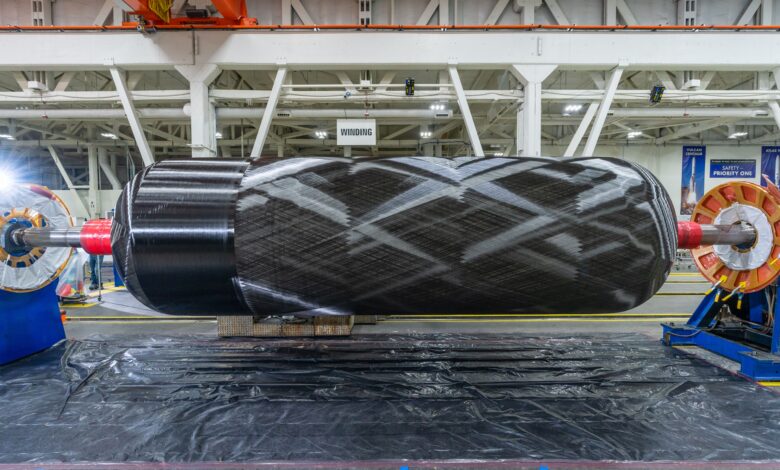
Northrop Grumman manufactures critical propulsion components in Utah, such as performing the case winding process for the Sentinel intercontinental ballistic missile program. (Photo Credit: Northrop Grumman)
Northrop Grumman’s operations in Utah are crucial for advancing American manufacturing while providing essential capabilities for defense and space. Here are some highlights:
- Strategic Investment: Building a Defense Economy. Northrop Grumman’s enduring partnership with Utah communities and service members is both long-established and transformative. As the state’s largest defense employer, Northrop Grumman employs over 10,000 individuals directly. A recent study revealed the company supports over 46,000 jobs statewide and generates more than $12 billion for the Utah economy through its network of over 600 partners.
- Digital Innovation & Systems Integration Hub. The Roy Innovation Center, strategically located near Hill Air Force Base, boasts advanced technology and resources that facilitate the development, testing, and integration of missile systems, including support for the Sentinel program. Its proximity to both Hill Air Force Base and propulsion test facilities at Promontory allows for seamless coordination and rapid advancements in mission-critical systems.
- Propulsion Powerhouse. Spanning 4.6 million square feet—equivalent to about 80 football fields—Northrop Grumman designs, manufactures, and tests a range of solid rocket motors at its Promontory and Bacchus facilities. These sites are equipped for comprehensive processes including propellant mixing, motor case fabrication, assembly, and static test firing, ensuring rigorous validation of propulsion systems.
- Accelerating Innovation. The SMART Demo, or Solid Motor Annual Rocket Technology Demonstrator, at Promontory accelerates innovation by integrating multiple aspects of design, analysis, manufacturing, and testing into one efficient development cycle. This program fosters the advancement of new propulsion designs and material qualifications, recently achieving lead time reductions of up to 75% for specific components.
- Advanced Manufacturing. In Salt Lake City, Northrop Grumman has committed over $110 million to upgrade its Copper Crossing campus into a state-of-the-art advanced manufacturing hub focused on solid rocket motors. The Clearfield site also produces high-strength aerospace components through sophisticated automated fabrication processes, positioning itself as critical for air and space platforms.
Northrop Grumman’s commitment to Utah exemplifies the synergy of scale, engineering excellence, and trusted partnerships in delivering vital capabilities for national security. These operations not only enrich the defense industrial base but also solidify Utah’s role as a key player in advanced manufacturing and innovation.
With nearly 100,000 employees and over 30 million square feet of manufacturing space—more than 500 football fields—Northrop Grumman is equipped to advance innovation at an unprecedented pace. Their manufacturing strategies enhance all phases from design and development to production and testing. Continuous investment in U.S. infrastructure, R&D, workforce, and supply chains reaffirms their commitment to meeting current and future national security demands.
Source: Northrop Grumman (2026-01-29T13:00:00Z)