

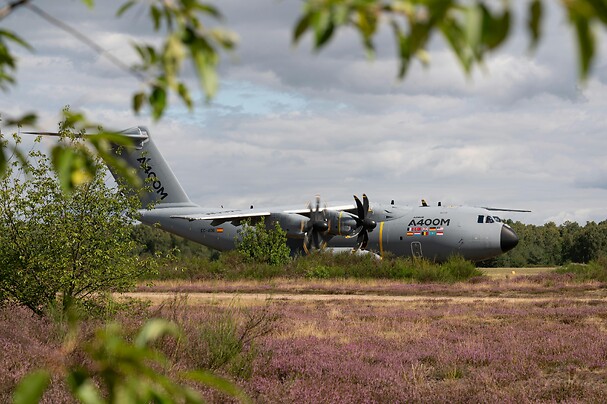
Bumpy, slippery, and green are the words used by Airbus Defence and Space test pilot Jon Taylor to describe the experience of landing a fully loaded 123-tonne military transport aircraft on grass. Even in these challenging conditions, the A400M continues to impress with its remarkable performance. According to Taylor, ‘This aircraft’s manoeuvrability is impressive. It does not defy physics, but sometimes it seems as if it is trying to.’
This latest flight test campaign was critical in enhancing the A400M‘s capability to operate from unpaved runways. The advanced technology of the aircraft allows precise landings on unprepared surfaces measuring less than 800 metres in length and 20 meters in width. Such capabilities surpass those of other heavy airlifters. These enhancements not only reaffirm the A400M’s reliability in service with ten forces worldwide, but also underscore Airbus’s commitment to continual evolution and improvement of this aircraft.
A game-changer for soft-field operations
The recent flight testing, conducted in Altengrabow, Germany, during the summer of 2025, aimed to demonstrate the A400M’s ability to function under extended weight conditions on softer, vegetation-covered runways. This testing is part of a broader capability enhancement agreement with the Organisation Conjointe de Coopération en matière d’Armement (OCCAR), which manages the program on behalf of the launch customer nations.
Project Chief Engineer Jorge Palau emphasised that the ability to operate an aircraft of A400M’s size from soft, vegetated runways represents a significant breakthrough for customers, enabling operations beyond current capabilities and providing vital flexibility for global challenges:
- Increased payload: Once certified, the enhanced capacity in these unpaved environments will allow the A400M to carry more personnel, materials, or vehicles, thus requiring fewer rotations and reducing risk in military contexts.
- Humanitarian missions: This improved payload capacity on soft-field runways facilitates the swift delivery of crucial goods and services closer to the points of need. For example, in January 2025, French A400Ms successfully landed at a small local airport on Mayotte Island to deliver aid following a cyclone. Furthermore, A400Ms from Turkey and four other armed forces played a crucial role in the humanitarian air corridor established in 2023 after the devastating earthquakes in eastern Turkey and Syria.
- Special Operations (SOF): The capability to utilize austere air facilities is essential in managing current global challenges. The A400M’s low-level flight capability increases its effectiveness, fostering missions that require discreet entry into operational areas for personnel extraction and transport of goods.
The French Air and Space Force demonstrated the A400M’s ability to take off and land from unpaved runways as narrow as 20 meters during a month-long deployment in French Polynesia in 2022.
Precision and collaboration in action
The Altengrabow trials, conducted in partnership with the German Armed Forces (Bundeswehr), necessitated precise coordination among multiple teams, incorporating daily testing efforts on the unpaved surface.
José Luis Jaraiz, Campaign Manager at Airbus Defence and Space, noted that thorough airfield characterisation—measuring bearing strength and completing daily spot checks—was essential for ensuring safe and efficient operations on the challenging surface. For pilots, the differences between landing on grass and paved runways were immediately apparent, beginning with careful visual navigation and aiming points. Taylor described the landing experience as akin to being in a washing machine due to the uneven terrain, although the A400M’s design helps smooth out such challenges.
The aircraft’s advanced Flight Control System, or fly-by-wire, significantly reduces pilot workload, making it comparable to flying a video game console. Taylor contrasted this experience with older aircraft like the C-130, which lack this modern technology. Coupled with the raw power of its four engines, the A400M can perform missions other aircraft cannot.
Lead Flight Test Engineer César González confirmed that data captured during the testing campaign—utilizing an automated instrumentation system gathering thousands of parameters in real time—will inform the future certification and delivery of this enhanced capability to customers. González also highlighted the A400M’s versatility as its key advantage, enabling it to execute various tactical missions such as in-flight refuelling, cargo drops, parachuting, and operations on short, unpaved runways.
The future of the A400M
With the current flight campaign complete, the next phases will involve additional testing, a certification process, and the delivery of the enhanced capability to the global fleet, all without requiring modifications to the aircraft. Looking ahead, the A400M program is evolving, with future plans featuring enhanced connectivity, increased payload capacity, and the potential to serve as a mothership for drones. These ongoing developments will ensure that the A400M remains an exceptionally versatile and capable military transport aircraft for years to come.
Source: Airbus Defence and Space (2025-11-17)