


Rheinmetall is driving new developments in autonomous military convoys
Rheinmetall MAN Military Vehicles GmbH has assumed full responsibility for the InterRoC VII (Interoperable Robotic Convoy VII) research project on behalf of the Federal Office of Bundeswehr Equipment, Information Technology and In-Service Support (BAAINBw). This initiative further solidifies Rheinmetall’s leadership in the development of highly automated military logistics systems and marks a significant step towards the digitalisation of military mobility.
This project responsibility comes shortly after Rheinmetall achieved top ranking in the ‘Convoy Scenarios’ category at the 2026 European Land Robot Trial (ELROB) held at the Thun military training area in Switzerland. Recognized as Europe’s premier demonstration platform for unmanned ground systems and autonomous robotics under realistic military conditions, ELROB provided the venue for Rheinmetall to showcase the capabilities of its autonomous logistics solutions in complex convoy and transport scenarios.
Advancements in Interoperable Convoys
InterRoC VII is the latest addition to the successful Interoperable Robotic Convoy research series, aimed at enhancing highly automated convoy control and testing interoperable vehicle formations that enable different vehicle platforms to operate safely and autonomously together.
The focus remains on efficient automation, perception and decision-making functions, as well as robust route planning for diverse vehicle formations. These cutting-edge technologies are designed to ensure reliable and safe convoy management, even under demanding military operational environments.
The HX Vehicle Family as a Technological Foundation
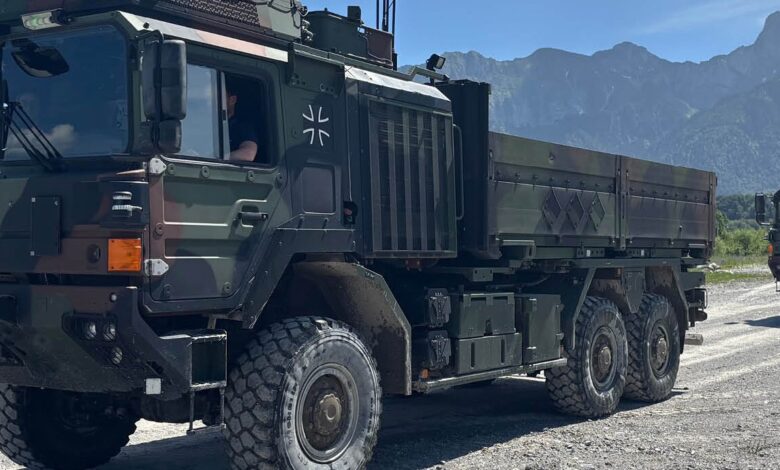
For the InterRoC VII project, Rheinmetall relies on its proven HX family of military logistics vehicles, which are equipped with Rheinmetall’s modular PATH sensor kit and a fully integrated ‘drive-by-wire kit’.
The open system architecture supports the continuous integration of additional sensors, AI-driven software functions, and mission-specific algorithms, allowing for a scalable autonomy platform that can be flexibly adapted to meet future requirements and operational scenarios.
Operational Independence from Satellite Navigation
The systems developed through this research project build upon Rheinmetall’s extensive prior research in autonomous land vehicles. The company has developed technologies enabling automated driving capabilities in real military settings, both on roads and off-road.
A principal technological highlight is the ability to operate reliably in so-called GNSS-denied environments. In the event of satellite-based navigation failure or interruption, vehicles can accurately map their surroundings, determine their location, and autonomously execute complex convoy operations. This capability offers a vital operational advantage, particularly in areas prone to electronic interference.
Demonstrating Capabilities at ELROB 2026
The abilities showcased during the ELROB 2026 event will be directly integrated into the InterRoC VII research project. This event provided a platform for demonstrating autonomous convoy management, sensor fusion, and decision-making algorithms under realistic conditions, which are further developed in collaboration with international armed forces, research institutions, and industry partners. The insights gained will inform the subsequent phases of the project.
Enhancing Military Logistics Digitalisation
With the InterRoC VII project, Rheinmetall emphasizes its position as a top global supplier of autonomous military logistics systems. Automating logistics transportation tasks enhances the efficiency and sustainability of military supply chains while mitigating risks to personnel in the field. Thus, this research project plays a significant role in the digital transformation of the battlefield and the evolution of next-gen networked military mobility solutions for the Bundeswehr.
Future collaborations with technology specialists, emphasizing AI to expand capabilities, will be pivotal. Driveblocks GmbH, as a specialist software and AI provider in object classification and environmental awareness, significantly contributes by developing modular autonomy and perception systems that fuse camera and LiDAR data with AI-based models. This technology targets robust, real-time mapping of complex 3D environments, including object classification, and is specifically designed for challenging off-road conditions, such as unstructured terrain, vegetation, dust, snow, and variable visibility. Its applications span across defense, construction, and agriculture sectors.