


One-way attack drones are altering the landscape of modern warfare, presenting a low-cost threat to high-value air defense systems. Enter Airbus’ latest innovation: the Bird of Prey.
Characterized by their simple design, off-the-shelf electronics, and piston engines, one-way attack drones are prevalent in theaters such as Ukraine and the Middle East. Recently, approximately 5,749 attacks were recorded involving Russian Geran-type drones in June 2026, translating to an alarming rate of 192 attacks per day. This rising tide of drones is overwhelming existing air defenses and challenging conventional military assumptions.
Theoretically, the most advanced technology should dominate. Yet, one-way attack drones reveal a significant imbalance: the costs associated with intercepting these threats can reach millions of euros, whereas the drones themselves are available for just tens of thousands.
This price discrepancy intensifies the demand for effective and economical countermeasures that can adapt to the evolving threat posed by drones with increasing speed and sophisticated flight paths. Solutions should be scalable and integrated into a comprehensive command and control (C2) framework to maintain relevance.

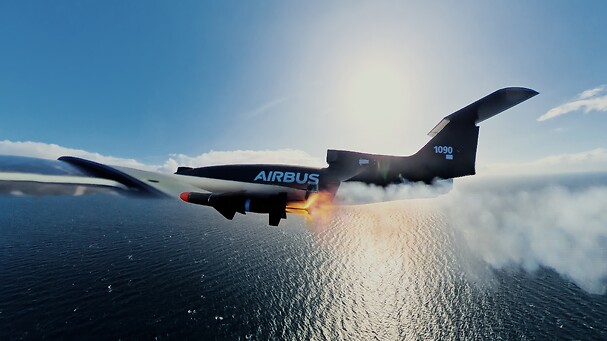
Bird of Prey Demo flight
Bird of Prey can autonomously engage threats over large distances.
Bird of Prey: the drone hunter
At Airbus Defence and Space, we are developing an effective response to this emerging threat: the Bird of Prey. This innovative uncrewed aerial system builds upon the Airbus Do-DT25 airframe, transforming from a standard target drone into a formidable drone hunter.
Upon launch from a catapult, the Bird of Prey will engage adversarial threats over extensive distances. It boasts the capability to accommodate various effectors tailored to specific mission requirements, emphasizing versatility and reusability. This adaptability is crucial to ensure a lower cost per engagement, a necessary factor in countering one-way attack drones.
Bird of Prey will be integrated into the Airbus Integrated Battle Management System (IBMS), enabling seamless compatibility with NATO’s air defense framework. Completely based on European technology, it circumvents any restrictions from the American International Traffic in Arms Regulations (ITAR), thereby ensuring full sovereignty in operations.

Bird of Prey demo flight
In March 2026, the Bird of Prey successfully executed a demonstration flight, neutralizing a one-way attack drone with a Mark I missile developed by Frankenburg Technologies.
From concept to combat ready
In a remarkable nine-month timeline, Bird of Prey has evolved from a conceptual idea to a demonstrable system, showcased during a flight in late March 2026 at a military training facility in northern Germany. Simulating a real-world scenario, Bird of Prey autonomously searched for, identified, and engaged a medium-sized one-way attack drone.
This autonomous engagement process allows the system to handle most operational tasks from detection to neutralization while maintaining human oversight. Once the threat is identified, the system requests authorization for engagement. Following approval from an operator—or autonomously if predetermined criteria are met—Bird of Prey proceeds to eliminate the threat, optimizing the balance between human decision-making and automated response to the growing presence of one-way attack drones.
Airbus is already in the process of planning further live trials throughout 2026 to enhance operational readiness for global clients. With the escalation of ‘drone wars’, Bird of Prey stands as more than just another weapon system; it symbolizes a proactive strategy to succeed in a new era of attrition warfare.
Source: Airbus Defence and Space (2026-07-08)