

What makes the A330 MRTT so special? At the core of its global appeal are the aircraft’s pioneering innovations in air-to-air refueling, the dual-use European civil-military technology, and the strategic autonomy it affords its operators.
More than a hundred years ago, two US Air Force DH-4B biplanes completed the first successful air-to-air refueling. Aviation historians recount how Lieutenant Virgil Hine and Lieutenant Frank W. Seifert had to lower a 15-meter hose manually, a risky maneuver while in formation. Their counterparts, Captain Lowell H. Smith and Lieutenant John P. Richter, were able to grasp the hose and connect it, allowing about 284 liters of fuel to be transferred.
Fast forward to today, where the hundreds of liters transferred in those early operations have evolved into sophisticated boom systems capable of delivering up to 4,500 liters per minute, and 1,500 liters through hose and drogue systems. Thanks to the Airbus A330 MRTT, a market previously dominated by US manufacturers until the late 2000s is now technologically led by Europe. This tanker aircraft can refuel 25 different receiver aircraft and offers global coverage for air forces with a range of up to 16,000 km.
The aircraft that can reach every corner of the world
Air-to-air refueling has allowed air forces to extend their operational reach and enhance their strategic capabilities. Presently, the A330 MRTT supports essential missions ranging from airpower projection and rapid troop deployment to cargo transport and humanitarian relief.
“Air-to-air refueling is an amazing aerial feat, but we have come a long way technologically,” says Juan Cabrera García, Flight Test Engineer & Test Aerial Refueling Operator at Airbus Defence and Space.
The development of the A330 MRTT’s boom system was pivotal to the program, operated from a dedicated console situated behind the pilot in the cockpit. “At Airbus, we had no experience in air-to-air refueling with a boom 20 years ago. Since our first experimental air-to-air refueling in 2007, we have developed the first 100% electric boom and the first high-definition 3D remote vision system, which set the benchmark for visual systems,” Cabrera explains.
Recent upgrades to this camera system now incorporate the latest sensor technology for both hose and boom operations, including covert capabilities. “This enables night refueling operations to be conducted without external lighting, allowing the receiver to perform operations with night vision goggles,” Cabrera adds, emphasizing reduced detectability for the MRTT.
“With the A330 MRTT, we are standing on the shoulders of giants. It all started 20 years ago when a talented group developed the first in-flight boom refueling system at Airbus, in what was then a single supplier market. Few could have imagined that the A330 MRTT would become the world’s leading tanker aircraft.” — María Ángeles Martí, Head of Tanker and Derivatives at Airbus Defence and Space
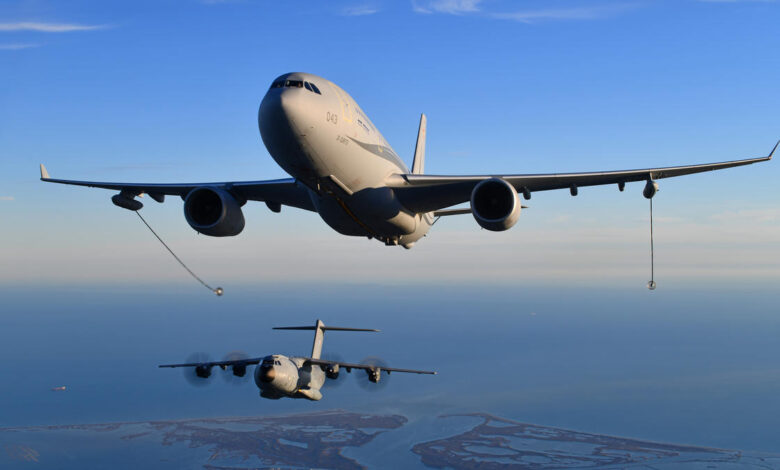
The Airbus A330 MRTT can refuel other aircraft using hose and drogue, boom refueling systems, or a fuselage refueling unit for larger probe-equipped aircraft like the A400M.
Leading innovation with automatic air-to-air refueling
Cabrera was also involved in the development and certification of the world’s first automatic air-to-air refueling (A3R) using a boom system on the A330 MRTT in 2022. “Air-to-air refueling has remained largely unchanged since the 1960s, requiring an operator for every phase. With the A330 MRTT, we’ve managed to automate several critical phases, enhancing safety and operational efficiency,” he notes.
This automation mitigates risk factors related to operator skill and training while consistently achieving superior performance compared to traditional manual operations. Airbus’s engineering teams are already working on integrating automatic capabilities for hose and drogue operations, aiming for a fully autonomous aerial refueling (A4R) capability, which has already been demonstrated in flight.
In March 2025, Airbus finalized certification tests for the A330 MRTT’s automatic night operation capability, with a final campaign to evaluate compatibility with Singapore Air Force’s receivers set for this Spring.
Civil to military: the importance of dual-use technologies
Innovation is vital for progress, and dual-use technologies bridging civil and military applications are evident in the success of the A330 MRTT, which holds a market share exceeding 90% outside the United States. Operators from 15 nations, including Australia, France, and NATO’s Multinational MRTT Fleet, now fly the aircraft.
“This program exemplifies civil aviation ingenuity reimagined for defense,” comments Guillaume Duchemin, Head of Military Derivatives at Airbus Commercial Aircraft.
Originally designed as a commercial airliner, the A330 is a twin-engine aircraft with over 1,800 orders to date. Following a nine-month upgrade process at Airbus’ facilities in Getafe, Spain, which involved around 50,000 modifications and 100,000 labor hours, the aircraft transforms into the Multi-Role Tanker Transport.
The next major evolution is the A330 MRTT+, which will utilize the A330neo (A330-800) instead of the A330-200 baseline design to facilitate reduced fuel consumption along with increased range and offload capacity. Future enhancements to components such as electronic warfare and connectivity are in progress. Moreover, learnings from the MRTT conversion offer valuable insights for new military derivatives, including a militarized version of the A321XLR for maritime patrol.
“Both commercial and defense teams share the commitment to continue evolving the product. Together, we anticipate a bright future,” concludes Guillaume Duchemin.
Source: Airbus Defence and Space (2025-04-24)