


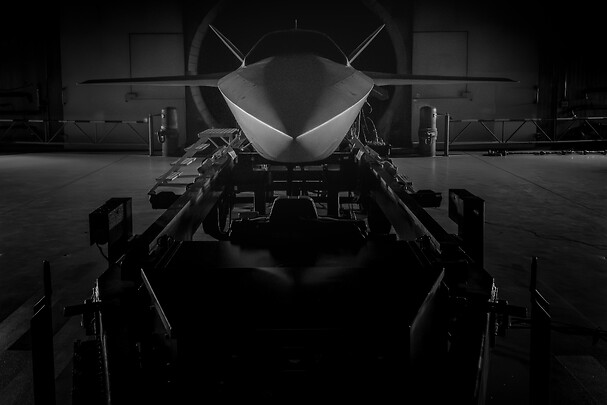
By the end of this decade, uncrewed collaborative combat aircraft (UCCA) are set to enhance the capabilities of crewed fighter jets on their missions. But what exactly is a UCCA? Below, we answer some of the most frequently asked questions surrounding this innovative technology.
Picture yourself as the pilot of a Eurofighter, assigned the challenging task of neutralizing an air defense position within a heavily fortified area. With the benefit of seamless connectivity, you’re not alone in this mission. All the vital information is displayed in your cockpit, and you maintain close communication with ground stations and fellow fighter jets. Notably, an UCCA is at your side, ready to execute your orders. You instruct the UCCA to take down the enemy air defense, and it penetrates deep into hostile territory, successfully destroying the target with a guided missile.
This may seem like a plot from science fiction, but Airbus is actively working to make it a reality. The company aims to operationalize UCCA capabilities with the German Air Force by 2029, launching the U740 Valkyrie, followed by the U760 Ravenstorm in the early 2030s. Below, we address key aspects of what defines uncrewed collaborative combat aircraft.
What is an uncrewed collaborative combat aircraft?
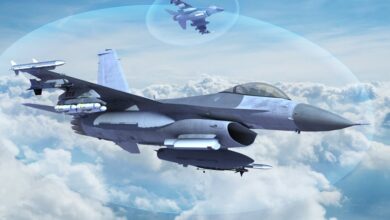
An uncrewed collaborative combat aircraft—also referred to as collaborative combat aircraft (CCA) or loyal wingman—is an autonomous armed aerial platform designed to operate alongside fighter jets. It can fly in formation, engage threats, and adapt to evolving battlefield conditions without the necessity for continuous ground control. The primary purpose of a UCCA is to enhance ‘combat mass’ during operations and extend the operational range of crewed aircraft such as the Eurofighter.
How does a UCCA collaborate with a crewed platform?
This is where the concept of crewed-uncrewed teamwork comes into play. In this dynamic, crewed platforms like the Eurofighter serve as command hubs while the UCCA acts as an operator’s extended capability. The pilot sets overarching mission objectives, which the UCCA then autonomously executes at predetermined levels of freedom. They can undertake specialized roles, such as one UCCA engaging enemy targets while others jam radar or collect battlefield intelligence, relaying critical data back to the pilot.
Such collaboration is facilitated by an advanced mission system that allows seamless operation between human operators and machines. The UCCA handles data processing and routine maneuvers, enabling pilots to concentrate on high-level strategy decisions.
Why are uncrewed collaborative combat aircraft critical in modern defense?
In contemporary warfare, the ability to process information and respond swiftly is paramount. This advantage persists well beyond the initial 24 hours of conflict; it is about sustained operational endurance.
Within this context, UCCAs act as force multipliers. They can be produced in larger quantities at reduced costs compared to manned jets, affording the necessary scale to counter threats and secure air dominance without overextending current resources.
The potential benefits for pilots are significant. UCCAs can alleviate pilot workload by handling various tasks, all while providing an additional defense layer. By undertaking high-risk missions, they ensure that crewed pilots remain away from immediate danger.
What distinguishes uncrewed aerial systems (UAS) from UCCAs?
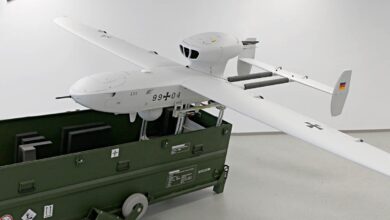
The term ‘uncrewed aerial system’ (UAS) encompasses a wide array of platforms, with UCCAs being a specialized subset. While all UCCAs qualify as UAS, not all UAS can be classified as UCCAs.
UASs come in numerous configurations and can be tailored for assorted missions—ranging from intelligence, surveillance, reconnaissance (ISR), and maritime patrol to cargo transport. In contrast, UCCAs are specifically designed to operate in contested airspaces, engaging in missions where traditional drones may be at risk of downing.
Many UAS require continual human oversight for navigation and maneuvering, whereas a UCCA is significantly more autonomous. When a pilot commands an UCCA to ‘scan a sector,’ the aircraft independently calculates the best flight path and manages its sensors, transmitting essential data back to the cockpit. Notably, UCCAs can perform operations in GNSS-denied environments where determine positioning via satellite is unfeasible due to jamming or geographical limitations, always executing tasks in accordance with the level of autonomy assigned to them.
How is Airbus advancing this capability?
Airbus is committed to equipping the German Air Force and its European allies with sovereign UCCA capabilities by the end of this decade. The company is taking a phased approach to ensure that these systems can integrate seamlessly into existing and future combat fleets.
The first significant step entails the introduction of the U740 Valkyrie, based on Kratos Defense & Security Solutions’ XQ-58 Valkyrie. By outfitting the Valkyrie with the Multiplatform Autonomous Reconfigurable and Secure (MARS) Mission System, Airbus aims to deliver a sovereign UCCA capability to the German Air Force by 2029. This initial phase will serve as the foundation for operational experimentation, introduce basic air-to-ground capabilities, and facilitate the collaboration between the Valkyrie and Eurofighter.
Currently, Airbus is focused on integrating the MARS system into the Valkyrie while preparing the first two acquired aircraft for their maiden flights, which are set for later in 2026.
Launched during the 2026 ILA International Air Show, the U760 Ravenstorm represents the next milestone in Airbus’s UCCA roadmap, advancing toward a scalable family of uncrewed collaborative combat aircraft. The Ravenstorm, which features a wingspan of 10 meters and a length of 13 meters, is engineered for multi-domain operations. Its capabilities encompass precision air-to-ground strikes, long- and medium-range air defense, as well as electronic warfare to neutralize enemy air defenses and carry out offensive counter-air maneuvers through non-kinetic jamming. The Ravenstorm is anticipated to be operational in the early 2030s.
Like the Valkyrie, the Ravenstorm will utilize Airbus’s MARS Mission System, built on software-defined defense concepts. Its modular, open architecture allows for continuous upgrades and expansions of the system’s software, ensuring adaptability to evolving mission requirements and maintaining long-term relevance for the platform.
For further insight into Airbus’ collaborative combat solutions, visit our dedicated page.
Source: Airbus Defence and Space (2026-05-05)