


Accelerating Production of National Security Space Assets with Additive Manufacturing
As competition in space intensifies, the ability to swiftly deploy and replace satellites has become crucial. L3Harris Technologies is tackling this issue head-on through additive manufacturing (AM), which is expediting the production of in-space thrusters. This advancement will enable rapid deployment and replenishment of the proliferated U.S. national security constellations and other dynamic space operations.
In-space thrusters are used for tasks such as satellite deployment, orientation, and maneuvering, existing in various sizes. Historically, these thrusters have been one of the most time-consuming components in satellite manufacturing, with an average lead time of 18 months from order to delivery.
This timeline is insufficient for a space-dependent national security sector seeking to accelerate satellite launches and enhance maneuverability under tight schedules. As a long-trusted supplier of dependable in-space propulsion systems, L3Harris is meeting this demand by shifting key component production from traditional machining to more efficient AM techniques.
“Our objective is to enable significantly reduced lead times on propulsion systems that traditionally have been a bottleneck,” stated Kristin Houston, President of Space Propulsion and Power Systems at L3Harris. “The goal is to remove up to 12 months from the in-space propulsion system delivery equation, and we’re well on track to achieve that.”
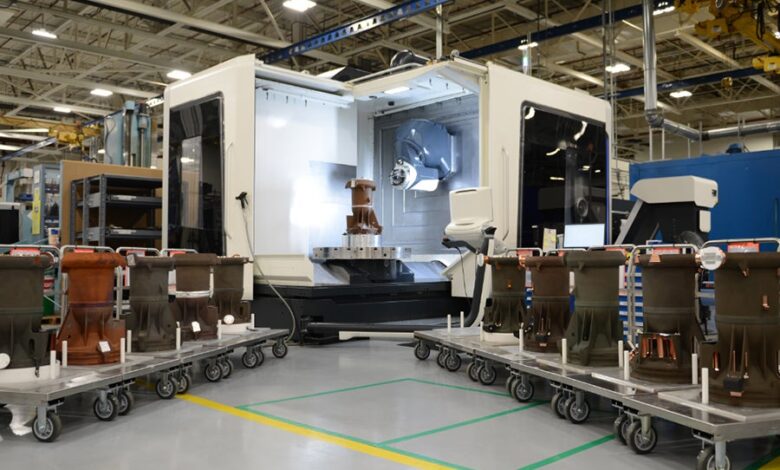
For over a decade, L3Harris has spearheaded efforts in AM, commonly known as 3D printing. Following its acquisition of 3D Materials Technology in Daytona Beach, Florida, in 2019, the company has significantly expanded its AM capabilities. This facility now produces crucial thruster components such as nozzles, manifolds, and combustion chambers, which were previously machined at other locations within the company.
These components are frequently made from high-strength, exotic metals like niobium, designed to endure the harsh conditions of spaceflight. Traditional subtractive manufacturing, which involves machining large blocks of these costly materials, can be excessively wasteful.
In contrast, AM allows L3Harris to procure these metals in powdered form, making them more cost-effective and easier to store. At the Daytona Beach facility, laser powder bed fusion is a prevalent manufacturing method. This entails layering powder onto a platform and utilizing a high-powered laser to melt specific areas according to computer-aided designs. The molten powder then solidifies to form each layer of the final part, a process that repeats layer by layer until completion.
L3Harris has successfully addressed one of AM’s major challenges: variability in quality across identical machines. By conducting extensive testing and adjustments, the company has reduced variability, enabling large-scale production while harnessing AM’s benefits, such as reduced part count, increased design flexibility, and shorter build-to-test cycles for rapid design iteration and refinement.
“The idea is to have multiple machines running simultaneously to achieve scale,” Houston continued. “L3Harris-built thrusters with additively manufactured components are now flight proven on national security satellites, both experimental and operational.”
The application of AM at L3Harris isn’t restricted to satellite thrusters. The company is also integrating AM into its RL10 engine, which powers the upper stage of United Launch Alliance’s Vulcan rocket family.
“We’ve been perfecting this over a decade,” Houston added. “We’ve established the necessary infrastructure and trained personnel, and we are already achieving high production rates.”
Beyond AM, L3Harris is stockpiling valves and other components utilized across various satellite propulsion systems. Collectively, these initiatives are quickly addressing what has historically been a critical production bottleneck in the manufacturing of the satellites that are vital to national security.
Source: L3Harris (2026-04-10)