Airbus technology supports the modernisation of the Spanish Air and Space Force
The modernisation of 21st-century air defence goes beyond the acquisition of individual aircraft. With Airbus’ help, the Spanish Air and Space Force is undergoing a profound transformation toward an interconnected and interoperable ecosystem, in which operational capabilities and European industrial sovereignty advance.
How to defend Spanish air space: present and future
In this documentary, Sergio Hidalgo, an aerospace engineer and science communicator, analyses the capabilities of the Spanish Air and Space Force. Don’t miss it!
—
0:01:24
Spanish Air and Space Force Documentary
With Airbus’ help, the Spanish Air and Space Force is undergoing a profound transformation toward an interconnected and interoperable ecosystem.
Connectivity: From the 5G bubble to Crossbond.
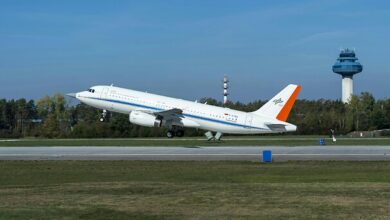
A hybrid attack severely damages backbone telecommunications infrastructure in the Canary Islands. Within minutes, terrestrial networks are rendered inoperable. To restore command and control (C2), a C295 takes off to deploy an aerial tactical bubble over the archipelago. From the air, the aircraft provides high-speed, ultra-low-latency connectivity, linking units on the ground from the air.
This scenario reflects capabilities that are already a reality. In 2025, Airbus and Telefónica successfully tested an airborne 5G Standalone (SA) communications system on a C295 at Albacete Air Base, marking the first airborne 5G deployment on a military platform in flight in Spain.
Airbus is continuing to develop advanced connectivity capability. The aim is to create a digital backbone for real-time data exchange between aircraft, helicopters and uncrewed aerial systems, as well as C2 nodes on land, at sea and in the air.
A strategic vision for a contested environment
This architecture aligns with the Spanish Air and Space Force’s Tactical Air Transport Strategy and Future Vision. In a year that marks the centennial of the great flights in Spanish military aviation, the Air Force is looking ahead.The roadmap establishes clear priorities: permanent availability, air superiority, space control, resilience and expeditionary projection.
“In an unstable geopolitical context, the Army emphasises the need to ‘enable’—that is, to maintain current capabilities and develop new solutions that meet its current and future needs. They trust us, and we cannot let them down,” says Esperanza Martín de la Fuente, Airbus Key Account Manager for the Air and Space Force.”
Airbus’ technology facilitates this transition toward a multi-domain environment. “The strategic cooperation p between Airbus, the Air and Space Force and other national defence companies supports the development of solutions aligned with operational needs,” she adds.

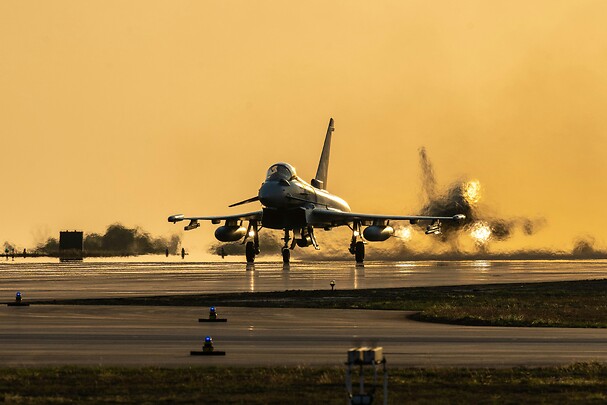
Airbus Fotos EFA Moron-21
From flight school to air superiority
The close relationship between Airbus, a driving force in the national defence industry, and the Spanish Air and Space Force begins with fighter pilot training. Replacing F-5 trainer jets is moving forward through the SAETA II programme. It involves the integration and adaptation of Spanish avionics on a fleet of 30 two-seat Hürjet aircraft, along with comprehensive operational and maintenance support. Airbus is also coordinating the modernisation of the Fighter and Attack School Training Centre at the 23rd Wing, located at Talavera la Real Air Base.
In air defence, the Eurofighter remains the backbone of national and allied sovereignty, as evidenced by NATO deployments in the Black Sea and the Baltic states. “In Spain, we provide round-the-clock service 24/7, 365 days a year, with aircraft on alert ready to take off in less than 15 minutes,” notes Commander Juan Bengoechea, a Eurofighter pilot.
Through the Halcón I and Halcón II programmes, the fleet will add 45 additional fighter jets, bringing the total to 115 aircraft by 2035. The recent replacement of the F-18s at Gando Air Base (Gran Canaria) have established the Eurofighter as the strategic guardian of NATO’s southern flank. “One of the key features of Tranche 4 [Halcón I and II] is the the integration of the active electronically scanned array (AESA) radar, which endows the aircraft with capabilities unprecedented in the Spanish Air and Space Force,” adds Bengoechea.
Smart infrastructure with BACSI
Operational modernisation converges with the Connected, Sustainable, and Smart Air Base (BACSI) project. This initiative optimises the logistical management of military bases. Gando in the Canaries will lead the implementation of digital sustainment processes under PERAM 145 certification, while the Albacete Air Force Maintenance Centre (MAESAL) is promoting predictive maintenance tools.
“Together with other industrial partners, we are working to provide the Air Force with a comprehensive end-to-end system that serves and supports all bases and logistics centres,” Martín de la Fuente stresses.

Spanish A400M Flight Display
Global projection, mobility and maritime dominance
The expeditionary capability demonstrated in international exercises such as Pacific Skies and Pitch Black relies on a combination of the Airbus A400M and Airbus A330 MRTT. With 27 units on order and 14 already in service, Spain’s A400M fleet, with its final assembly line at Airbus in Seville and based at Wing 31 in Zaragoza, has significantly increased range and payload capacity compared to the C-130 Hercules. The aircraft supports strategic transport, parachute and cargo drops, tactical refueling and humanitarian missions. Airbus has also developed a removable fire-extinguishing kit with a capacity to discharge 20 tonnes of water or fire retardant, designed for indirect use in large fires.
Meanwhile, the A330 MRTTs of Group 45, converted from a A330 civil airliner to a military aircraft at Airbus’ facilities in Getafe, provide strategic refueling of up to 111 metric tons of fuel, medical evacuation and transport over transcontinental distances. Based on the A330 commercial airliner, Airbus applies its in-depth technical and military expertise in Spain to modify and convert these airframes into military tanker aircraft at its Getafe plant.
“The Army is very satisfied with the performance and versatility of the MRTTs, which are successfully carrying out various missions,” explains Martín de la Fuente.
“ Furthermore, Airbus has been contracted to manage the Transport Crew Training Centre at Matacán Air Base, just as we will do in the future at the Training Centre at Talavera la Real base for fighter pilots. This is a shift in mindset for them, which demonstrates their great trust in us.”

A330 MRTT refuelling Eurofighters
In the maritime sphere, the phasing out of the P-3 Orion aircraft makes way for 16 Airbus C295 aircraft in maritime patrol (MPA) and surveillance/rescue (VIGMA/SAR) configurations, which will replace the current fleet of Airbus CN-235s. Equipped with submarine detection systems, precision armament, Link 22 tactical data link and secure satellite communications, the new C295s will monitor the national coastline.
The arrival of the new aircraft coincides with the 25th anniversary of the C295’s entry into service in its basic transport configuration; Spain has ordered 18 new units of this model. In total, the country will operate a unified fleet of 46 C295s, which will allow it to maximise operational and training synergies. In addition, further NH90 tactical helicopters assembled in Albacete will be delivered for naval and rescue missions.

1st flight NH90 Ejército del Aire y del Espacio (Spain)
Uncrewed systems, space and collaborative combat
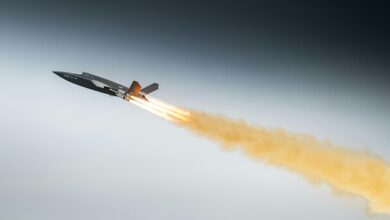
Operational superiority also requires real-time intelligence. In the uncrewed segment, Airbus has developed the U850 SIRTAP. Designed to be transported on a C295, it will provide persistent surveillance during forward deployments. At the same time, the European U950 Eurodrone programme, whose production will take place at Airbus’ Tablada facility, will provide a strategic Intelligence, Surveillance, Target Acquisition and Reconnaissance (ISTAR) capability with long endurance (MALE RPAS) that will strengthen Europe’s autonomy.
Tactical coverage is complemented by Earth orbit. Coordinated by the Space Command established in 2023, the Spanish Air and Space Force already operates the Airbus-built PAZ satellite, which uses radar to obtain images of the Earth’s surface through cloud cover. These capabilities will be enhanced by two new PAZ satellites, which Airbus is manufacturing for entry into service in 2031. Meanwhile, the SpainSat-NG constellation, also manufactured by Airbus and operated by Hisdesat, ensures the security of military communications.
Through the deployment of the BACSI concept, as well as the evolution of the Eurofighter programme and the new capabilities provided by platforms such as the A330 MRTT, C295 MPA, and uncrewed systems, Airbus and the Spanish Air and Space Force are building an adaptable and resilient defence system to meet the challenges of tomorrow.

Ejército del Aire y del Espacio: modernización con Airbus
Source: Airbus Defence and Space (2026-11-06)