
The Nordic Compass Defence Statement
In this ongoing collaborative effort, we have resolved to concentrate on four specific initiatives.
Four Initiatives for a Safer Nordic Region
Space: Federated Nordic Space Defence Capabilities.
The Nordic region can enhance European security by establishing and interlinking sovereign space-based capabilities. No single Nordic country is equipped to provide continuous satellite coverage for Arctic intelligence, surveillance, and reconnaissance (ISR), or for space-based missile early warning systems. We propose to bolster and develop a collective Nordic missile warning system that leverages space capabilities to enhance Arctic ISR and ensures secure, resilient communications that connect national assets with terrestrial and tactical networks—thereby integrating sovereign national assets to share awareness, data, and tasking.
Subsea: Protecting Critical Maritime Infrastructure.
Nordic cables, pipelines, ports, and offshore infrastructure are increasingly vulnerable to sabotage and hybrid threats. Current monitoring and response efforts are fragmented across various owners, authorities, and borders, complicating sensor data sharing without reliable, interoperable connectivity and standardized accreditation rules. We propose to create a unified Nordic maritime picture that encompasses both surface and subsurface elements, starting with critical offshore assets, ports, and their associated logistics and supply chains.
Connectivity: A Borderless Nordic Digital Backbone.
Transforming investments in advanced defence systems into operational capabilities hinges on the establishment of a robust connectivity framework. We envision a secure, trusted digital backbone that is multi-layered and multi-carrier, incorporating 3GPP standards and satellite communications as essential components. This backbone will extend from civilian infrastructure and military installations to the tactical edge, enabling Nordic and Allied forces to operate seamlessly across borders. It will support military mobility, integrated air and missile defence, and counter-drone measures for protecting critical infrastructure. We propose to develop a shared architecture that embeds connectivity into platforms and acquisitions right from the outset, positioning the Nordics at the forefront of NATO’s Multi-Domain Operations and the EU’s military mobility agenda.
A New Nordic Defence Industry Model.
Currently, requirements, certification, and procurement processes operate within five separate national frameworks, leaving industry without a unified demand signal for investment. To respond to the pressing needs of the situation more swiftly and cost-effectively, we advocate for the creation of a seamless Nordic acquisition chain. This would allow testing, certification, and purchases conducted in one country to be recognized and accepted across all participating Nordic nations, while preserving national decision rights, thereby ensuring that new capabilities reach users within months rather than years. We propose four initial steps: establishing a rapid-prototyping defence innovation environment supported by a buyers’ club; mutual recognition of certification; a collaborative Nordic capability roadmap; and a pilot framework contract that funds production capacity.
Our Commitment and Invitation
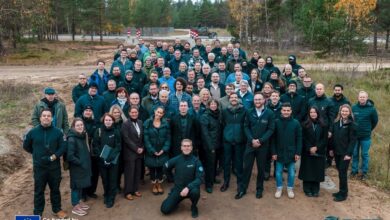
As industry leaders, we stand ready to contribute. Our senior executives and technical experts are dedicated to advancing these initiatives in strict adherence to competition rules, benefiting the broader Nordic ecosystem which includes small and medium-sized enterprises. Each initiative is designed to align with and enhance NATO and EU security objectives.
We extend an invitation to the governments of Denmark, Finland, Iceland, Norway, and Sweden—particularly their defence authorities and armed forces—to collaborate with us in the development of these initiatives. United, we can fortify the Nordic region, making it safer, more resilient, and more competitive as well as a more effective contributor to European and Allied security.
Ericsson · Kongsberg · Nokia · Patria · Saab · Terma