



L3Harris Technology Set to Help Unlock the Universe as NASA’s Roman Space Telescope Nears Launch
NASA’s Roman Space Telescope, slated for launch no earlier than August 30, is positioned to revolutionize our understanding of the cosmos. This mission will not only capture images of space but will also create the largest and most detailed maps of the universe, probing dark energy, identifying thousands of distant worlds beyond our solar system, and documenting sweeping perspectives of billions of galaxies.
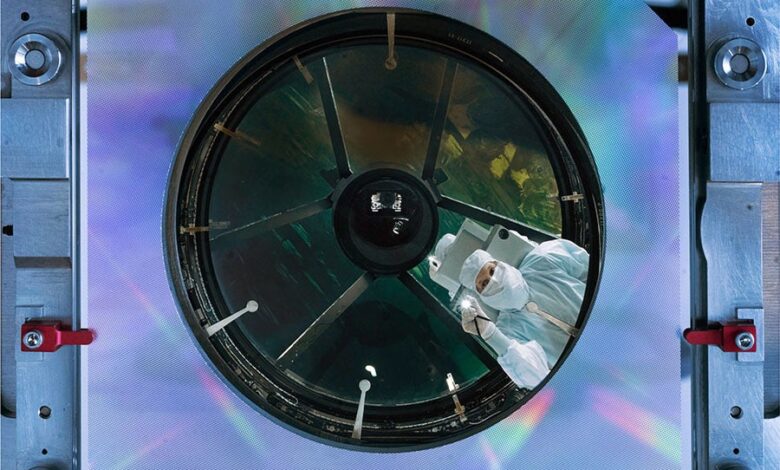
The cornerstone of these groundbreaking discoveries is the L3Harris-built Optical Telescope Assembly (OTA), which acts as the observatory’s optical eye. With a 2.4-meter primary mirror and a field of view approximately 100 times greater than that of the Hubble Space Telescope, Roman will conduct its surveys nearly 1,000 times faster than Hubble, yielding an unprecedented volume of scientific data while ensuring exceptional image quality.
“Building Roman required solving engineering challenges that pushed the limits of optical precision, stability, and reliability,” remarked Jeff Hanke, President of Space Systems at L3Harris Technologies. “Roman represents one of the most ambitious observatories ever built, and we’re incredibly proud that the optical system engineered by L3Harris will enable discoveries scientists haven’t even imagined yet. Every image Roman captures has the potential to rewrite what we know about our universe.”
Post-launch, the L3Harris Optical Telescope Assembly is expected to perform impeccably after traveling nearly one million miles to the Sun-Earth L2 Lagrange point, where the gravitational balance offers an ideal setting for deep-space observations.
L3Harris’ expertise in designing and manufacturing the optical telescope is complemented by a long-standing commitment to developing mission-critical technologies that enhance the observatory’s operational precision. This includes high-reliability communications infrastructure that can transmit vast amounts of scientific data back to Earth, precision guidance sensors ensuring the observatory’s accurate positioning, and radiation-hardened electronics designed for extended durability in the harsh conditions of deep space.
Enabling Roman’s exploration of dark energy, an elusive force driving the universe’s accelerating expansion, L3Harris technologies will support the telescope’s comprehensive census of exoplanets using a coronagraph, aiding scientists in understanding how planetary systems form throughout the Milky Way.
Designed and manufactured at L3Harris’ facility in Rochester, NY, the optical telescope assembly and associated electronics highlight the company’s decades-long legacy of delivering advanced space optics and critical technologies for NASA and crucial civil and national security space initiatives.
As the Roman Space Telescope embarks on its mission, L3Harris technology will function as humanity’s gateway to discovering the universe’s oldest galaxies, most distant stars, and most profound mysteries, helping to reveal insights that could reshape our understanding of the cosmos for years to come.
Learn more about the Nancy Grace Roman Space Telescope
Source: L3Harris (2026-08-24)