



Northrop Grumman’s Layered Missile Defense: An Active Shield for Evolving Threats
As the geopolitical landscape rapidly evolves, the demand for a resilient and adaptable missile defense network has intensified. Northrop Grumman’s layered missile defense strategy merges existing capabilities with future technologies, delivering a cost-effective solution to enhance deterrence for the United States and its allies.
Employing digital engineering and advanced manufacturing, and collaborating closely with government and industry partners, Northrop Grumman accelerates the development and production of missile defense systems. This results in a comprehensive, multilayered shield that is quicker to deploy, more affordable to manufacture, and adaptable across various domains, thus safeguarding the United States and its partners against current threats while preparing for future challenges.
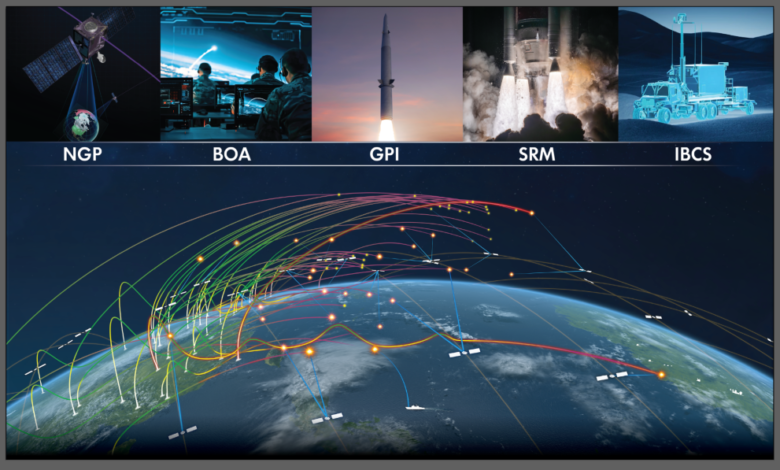
Northrop Grumman’s layered architecture enables hostile missiles to be detected in space, tracked by maritime sensors, and intercepted using the most effective method—whether a kinetic interceptor launched from a frigate or a ground-based system. This creates a resilient network where a detected threat is monitored through multiple domains, classified with artificial intelligence, and assigned the most suitable interceptor before entering the defended area. The outcome is a streamlined kill chain from initial detection to successful engagement, capable of addressing the speed of modern threats.
“Northrop Grumman is integrating next-generation sensors and advanced interceptors coupled with AI-driven decision-making to empower warfighters to detect threats earlier, make swift and informed decisions, and adapt to evolving challenges,” said Rob Fleming, Northrop Grumman’s corporate vice president and president, Space Systems. “By interconnecting these capabilities via a software-driven approach, we offer warfighters a clearer view of the battlespace and broaden their response options.”
Key Components of Missile Defense
- Next Gen OPIR Polar: These next-generation satellites will operate in highly elliptical orbits, providing comprehensive early warning coverage for the Northern Hemisphere, equipped with modern sensors capable of detecting faint heat signatures from ballistic and hypersonic threats.
- Ballistic Missile Defense System Overhead Persistent Infrared Architecture (BOA): This architecture transmits actionable data from multiple satellite constellations, enhancing rapid decision-making and facilitating active responses.
Outpacing Emerging Threats
- Glide Phase Interceptor: This interceptor is specifically designed to counter hypersonic threats during their most vulnerable phases.
- Solid Rocket Motors & Propulsion Solutions: Northrop Grumman has produced over 1.3 million solid rocket motors and is ramping up production from 13,000 units in 2024 to 25,000 by 2029.
Command & Control Integration
- Integrated Battle Command System: This system links sensors and effectors, enabling them to function cohesively within one command and fire control framework.
Affordability Through Innovative Design
Advanced capabilities must also be affordable and scalable. Northrop Grumman incorporates cost-effectiveness into each subsystem, leveraging additive manufacturing, modular avionics, and digital design to decrease both acquisition and lifecycle expenses while enabling large-scale production.
- Additive Manufacturing: Critical interceptor components are 3D printed on-site using titanium alloys, significantly reducing lead times and mitigating tooling costs.
- Modular Avionics: The Modular Avionics Control Hardware can be rapidly configured to accommodate various launch vehicle control needs.
- Digital Twin-Centric Development: Virtual simulations throughout the design phase minimize risk, expedite schedules, and maintain design flexibility.
International Collaboration for Enhanced Defense
Addressing hypersonic and advanced missile threats requires multinational cooperation. Northrop Grumman is committed to working with key allies to establish an extended defensive shield and bolster deterrence across Europe and the Indo-Pacific.
The company is collaborating with the Japan Ministry of Defense to prioritize cost-effective solutions for global demands in missile defense technologies. Notable multinational cooperation agreements have been formed with the United Kingdom, Japan, Australia, and various NATO members to achieve three key objectives:
- Shared Procurement: Joint acquisitions will reduce per-unit costs for all members, leading to more economic solutions.
- Interoperable Data Standards: The adoption of open architecture ensures seamless sensor and shooter integration among allied forces.
- Co-Located Basing: Ground stations placed in Europe and the Indo-Pacific will provide allied nations with real-time situational awareness, enhancing the defensive perimeter beyond U.S. borders.
From initial detection to successful engagement, Northrop Grumman’s layered missile defense system actively protects the United States and its allies daily. By blending immediate capabilities with digital and adaptable architecture, the company is preparing to ensure that the nation remains ahead of future threats.
Source: Northrop Grumman (2026-08-10T14:19:00Z)