F-35C Lightning II Completes First Launch and Recovery Aboard a Gerald R. Ford-Class Aircraft Carrier
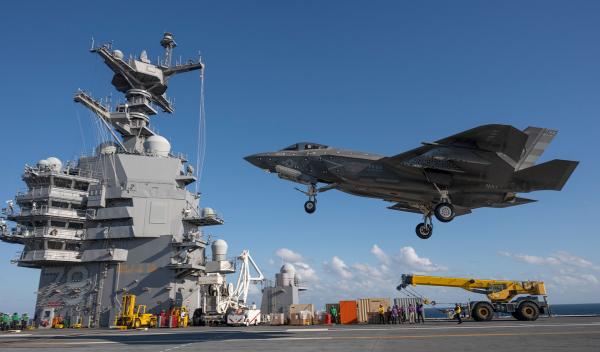
PATUXENT RIVER, Md., Nov. 19, 2026 – In a significant milestone for naval aviation, the F-35C Lightning II performed its inaugural recovery aboard the USS John F. Kennedy (CVN 79), a Gerald R. Ford-Class aircraft carrier, on the 251st birthday of the U.S. Navy, October 13. This event ties together the Navy’s rich legacy with the advancements of next-generation naval airpower.
The successful tests marked the first shipboard compatibility trials of the F-35C on the newest aircraft carrier of the Navy, showcasing its capacity to safely launch and recover from the advanced flight deck while generating vital data essential for upcoming carrier operations. Over a testing period of 11 days, two F-35Cs from Naval Air Station Patuxent River, Maryland, accomplished a total of 34 flights, 122 catapult launches, and 122 arrested landings utilizing the Electromagnetic Aircraft Launch System (EMALS) and Advanced Arresting Gear (AAG)—cutting-edge technologies designed for carrier-based operations.
“This is a critical event for the F-35C, Kennedy, and the United States Navy,” stated Sean Jackson, Lockheed Martin’s Vice President of the F-35 Development Program. “For the first time, the aircraft has successfully demonstrated launch and recovery operations from a Gerald R. Ford-Class flight deck, enhancing the integration of fifth-generation fighter capabilities with the world’s most advanced carrier technology. With the completion of this testing phase, the Navy has now cleared the F-35C to operate across its entire fleet of aircraft carriers.”
A New Carrier Environment
The introduction of Ford-Class carriers represents a revolutionary operational environment, characterized by:
- Electromagnetic Aircraft Launch System (EMALS) for smoother, precisely controlled aircraft launches
- Advanced Arresting Gear (AAG) designed for a wider range of aircraft recovery operations
- A redesigned flight deck and island to improve airflow, exhaust dynamics, and overall deck operations
Testing Delivers Critical Data
The recent at-sea tests followed shore-based trials from January 2024 to May 2025, allowing the integrated test team to gather essential information which supports:
- Verification of EMALS and AAG software alongside shipboard installations
- Validation of the F-35C’s loads and structural models for launch and recovery
- Development of Aircraft Launch Bulletins and Aircraft Recovery Bulletins for Ford-Class carriers
- Confirmation of mission-system software stability, initially testing Block 4 software in a carrier environment
- Assessment of supportability of aircraft within the new carrier environment
Advancing 5th Generation Carrier Capability
This achievement underscores the F-35C’s readiness to operate effectively from America’s next generation of aircraft carriers. Its stealth, advanced sensors, and data-sharing capabilities furnish a robust framework for future maritime and joint-force operations. The successful completion of testing aboard the Ford-Class pushes the F-35C program closer to full operational integration with the fleet’s newest carriers.
About Lockheed Martin
Lockheed Martin is a global defense technology enterprise that fosters innovation and accelerates scientific discovery. Our all-domain mission solutions and 21st Century Security® vision drive the delivery of transformative technologies that keep those we serve ahead of emerging threats. For more information, visit Lockheedmartin.com.
Media Assets
Photos: Access NEW high-resolution imagery from the Sea Trials here.
Media Kit: Find supporting resources on the F-35 program here.
# # #
Media Contact:
Mireya Villarreal, mireya.m.villarreal@lmco.com
Source: Lockheed Martin (2026-11-19 12:30:00)