

Airbus networked intelligence: Shaping the future of autonomous UAV missions
During the 2026 ILA Berlin Air Show, two Primoco uncrewed aerial vehicles (UAVs) demonstrated their capabilities in live autonomous missions. This event not only showcased advanced hardware but also highlighted the innovative intelligence driving these aircraft, accentuated by the announcement: “Don’t just watch it fly… watch it think!”
This significant demonstration marked the first instance of a collaborative autonomous flight with uncrewed assets at a major public trade show in Europe. The pioneering AI-driven collaboration was powered by Airbus’ Multiplatform Autonomous Reconfigurable and Secure (MARS) Autonomy application suite. Thomas Schmitt, Programme & Product Manager for Crewed-Uncrewed Teaming & Autonomy at Airbus Defence and Space, stated, “We are moving away from machines that we simply ‘drive’, and moving toward systems that can actually think and work together.”
Transforming Operations: From Individual Control to Collective Intelligence
Traditionally, the operation of UAVs requires constant attention and effort from dedicated operators for each vehicle. While modern drones can utilize AI for object recognition, human operators remain critical to tactical management.
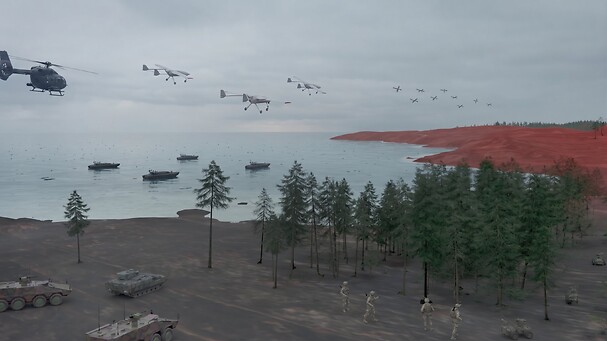
Airbus aims to revolutionize this aspect by offering a software-defined defense approach that facilitates autonomous teaming with networked intelligence. Rather than having separate operating controls for multiple platforms, multiple drones can now operate under a single, unified intelligence system. Schmitt compared this to a professional football team: “A football team doesn’t need a coach to tell every player exactly where to move their feet every second; the players understand the goal, they work together collaboratively. With our system, we don’t have several drones with several brains; we have one single brain controlling multiple drones that are completely in sync.”
The live demonstration was a clear validation of this technology. Throughout the flight, the UAVs performed two autonomous missions: a multi-role surveillance operation and a fast-paced surveillance mission. This scalable approach allows for the seamless inclusion of additional UAVs and roles, significantly enhancing operational effectiveness.
The initial operational deployment of this innovative solution on the Primoco One 150 UAVs is planned for 2026. The system’s design is agnostic, enabling integration into various proprietary or third-party crewed or uncrewed platforms.
Empowering Operators with Meaningful Human Control
By offloading the intensive cognitive burden of flight management to AI-enhanced software, the role of UAV operators has notably evolved. No longer are operators confined to monitoring screens; they transition into high-level mission managers.
This new level of autonomy guarantees that operators maintain ‘meaningful human control’ throughout missions. Schmitt explained, “Guided by the rules of engagement, we maintain a clear hierarchy of control. The system autonomously manages non-critical tasks while the operator retains the authority for critical decision-making. This ensures human judgment guides sensitive mission elements.”
Operational Capabilities of MARS Autonomy
The MARS Autonomy suite offers a comprehensive array of operational functions tailored for complex scenarios:
- Multi-platform mission planning: Automated task assignment and routing.
- Mission management: Real-time task execution and adaptive replanning.
- Data distribution: Automatic target recognition (ATR), data fusion, and live video broadcasting.
- Flight management: Automated maneuvering, route adherence, and obstacle avoidance.
For instance, during real missions, an operator may simply command the system to “Find all surface-to-air missile systems in the defined area, provide coordinates, and a video.” The Airbus technology autonomously distributes these tasks among the networked platforms.
MARS: Much More Than Just Combat Capability
The MARS Autonomy suite is pivotal to the greater MARS Mission System family, Crafted to adapt swiftly to emerging threats, this software-defined architecture promotes continuous improvement via updates. Airbus likens this dynamic evolution to a smartphone, where varying applications fulfill specific operational requirements.
Setting the Foundation for Future European Sovereignty
The MARS Mission System is integral to Airbus’ Uncrewed Collaborative Combat Aircraft (UCCA) strategy. A significant milestone in this initiative will see the MARS system integrated into the Airbus U740 Valkyrie, planned for 2029, thereby ensuring a sovereign solution that complements the Eurofighter. This will be followed by the fully sovereign Airbus U760 Ravenstorm expected by 2032.
Source: Airbus Defence and Space (2026-07-26)