


Northrop Grumman Deepens Defense Collaboration in Central and Eastern Europe
KIELCE, Poland – Sept. 10, 2026 – Northrop Grumman is enhancing its engagement in Central and Eastern Europe with new memorandums of agreement (MOUs) aimed at equipping NATO allies with advanced and modernized defense capabilities. The announcement, made during the MSPO International Defence Industry Exhibition in Kielce, Poland, underscores Northrop Grumman’s commitment to aligning its cutting-edge technologies with the priorities and industrial capacities of the region to bolster deterrence and defense across the alliance.
- New Industrial Collaborations in Estonia: Northrop Grumman has entered into two new MOUs with Estonian firms Go Craft for defense system integration and DefSecIntel for specialized mast fabrication and production. These collaborations will support the Integrated Battle Command System (IBCS), which is currently operational with the U.S. Army and Poland, positioning IBCS as the preferred command and control solution in Europe.
- Strengthening Weapons Production and Land Domain Capabilities: The Bushmaster® family of Chain Guns is integral to the Polish Rosomak and Borsuk vehicles, delivering critical medium-caliber firepower for the Polish Armed Forces. Northrop Grumman is intensifying its partnership with Huta Stalowa Wola to facilitate technology transfer, service, and support for Bushmaster cannons, addressing the rising demand for dependable medium-caliber firepower.
- Enhancing Maritime and Air Surveillance with the E-2D: The Northrop Grumman E-2D Advanced Hawkeye airborne command and control aircraft is pivotal in supporting integrated air and missile defense missions, offering decision dominance and battlespace awareness. Northrop Grumman is engaged in discussions with Poland regarding the adoption, training, and industrial collaboration for this essential platform.
- Countering Complex Aerial Threats with Raid Hunter™: The Raid Hunter™ system is designed to protect against UAS, drone swarms, and cruise missiles, filling critical short-range air defense gaps. This system offers a robust, cost-effective solution with its guided 50mm interceptors, enhancing survivability against swarm tactics and reinforcing layered missile defenses.
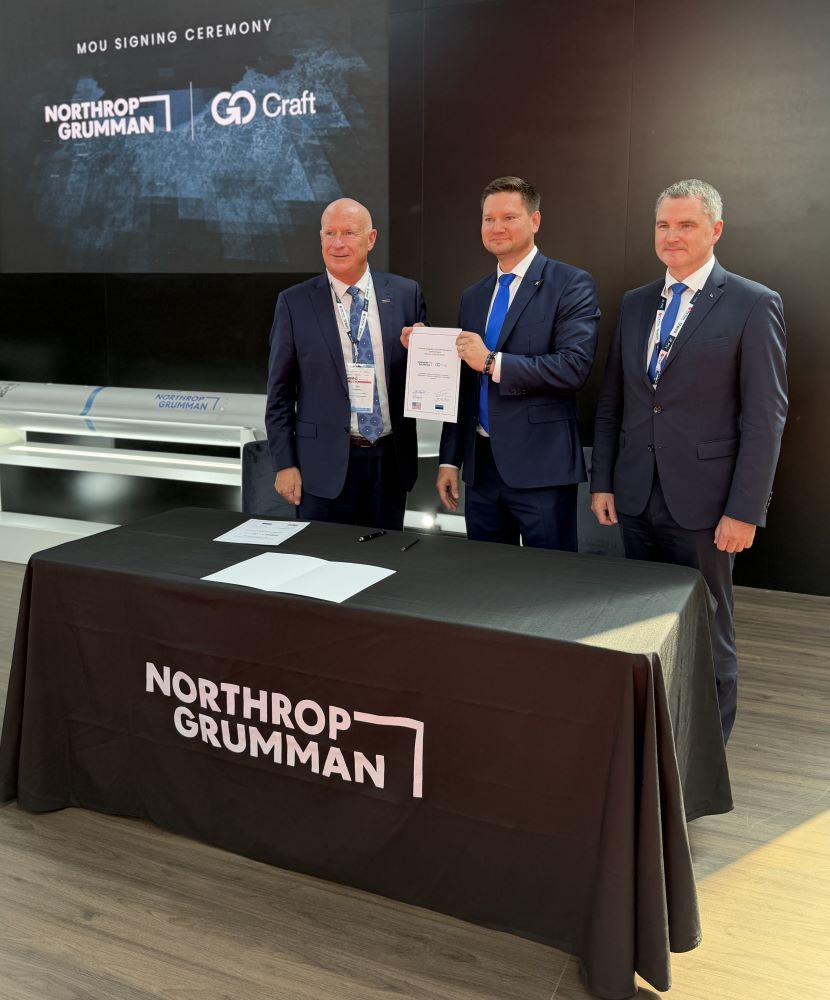
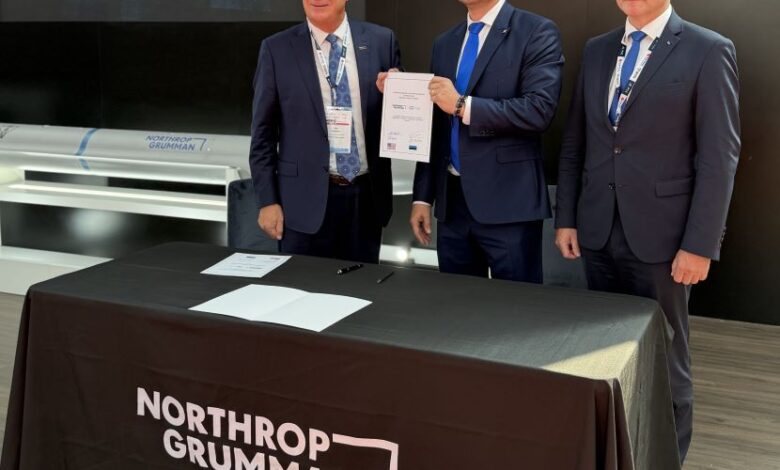
Estonian Undersecretary of Defence for Industry and Innovation Siim Sukles observes the signing of strategic MOUs between Northrop Grumman and Estonian industry partners on Sept. 9 at MSPO. Pictured are (from left to right) Tom Feldhausen, IBCS European regional director at Northrop Grumman; Tormis Saar, CEO of Go Craft; and Sukles. (Photo Credit: Northrop Grumman)
Expert Insights
Ben Davies, corporate vice president and president of Defense Systems at Northrop Grumman, stated: “Central and Eastern Europe is at the forefront of efforts to strengthen NATO’s collective defense posture. By deepening our collaboration with local industries and aligning our advanced, modernized capabilities with the needs of regional allies, we are contributing to a more integrated, resilient, and effective defense architecture across domains.”
System Details
Integrated Battle Command System (IBCS): This revolutionary system streamlines fire control quality data and battle management, ensuring interoperability among current and future systems regardless of source, service, or domain. Its open and scalable architecture allows for real-time sensor data fusion, delivering an actionable view of the battlespace. IBCS is currently in full-rate production and operational in Poland, supporting regional defense initiatives.
Bushmaster® Family of Chain Guns: Northrop Grumman’s Bushmaster® Chain Gun® offers unmatched reliability and effectiveness, serving as a next-generation capability for the U.S. and its 65 allied nations across various combat platforms.
E-2D Advanced Hawkeye: This platform boasts advanced sensing abilities, enabling commanders to make data-driven decisions in dynamic environments. Seamlessly operable with U.S. and allied forces, the E-2D features sophisticated radar systems capable of detecting numerous targets simultaneously, enhancing operational efficacy in multi-threat scenarios.
Raid Hunter™: Optimized for defeating mass aerial raids, the Raid Hunter uses guided 50mm interceptors to target threats that evade initial missile defenses. Its modular design allows for swift deployment and adaptation, making it a key element of Northrop Grumman’s comprehensive air defense solutions.
About Northrop Grumman
Northrop Grumman stands as a premier aerospace and defense technology leader, delivering innovative solutions that meet customer demands while advancing human exploration beyond Earth. The company aims to solve the most pressing challenges faced by its clients and define what is possible.
Source: Northrop Grumman (2026-09-10T13:59:00Z)