



The Future of Urban Air Mobility | Dubai Airshow
Introduction
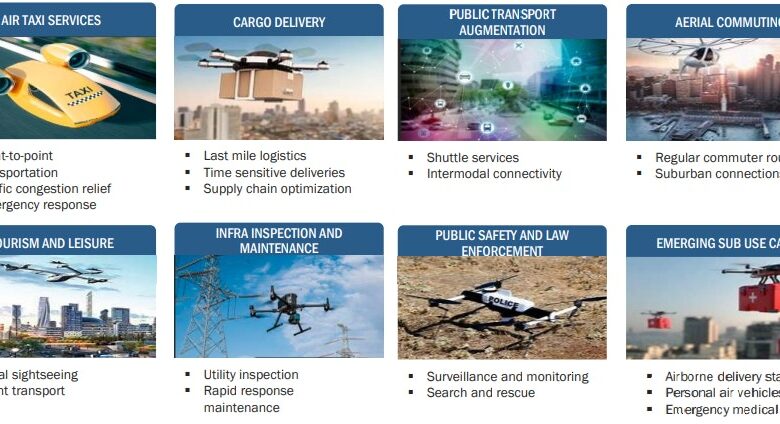
Electric vertical takeoff and landing (eVTOL) aircraft, aerial taxis, and drone delivery systems are set to revolutionize urban transportation in the near future. By leveraging advances in electrification, autonomy, and air traffic management, these technologies aim to alleviate road congestion and offer innovative mobility options in cities. eVTOLs, designed for short-range, point-to-point trips, will enable commuters to avoid traffic delays, drastically reducing travel times for both intra- and inter-city journeys. Additionally, aerial taxis will facilitate on-demand, shared air mobility, establishing a network of urban air routes akin to ride-hailing services, but with greater speed and efficiency.
Moreover, drone delivery systems are changing the logistics landscape by providing quick, cost-efficient, and contactless delivery of various goods, ranging from online shopping parcels to medical supplies. This advancement will lessen reliance on traditional delivery trucks, thereby cutting emissions and reducing curbside congestion. As these developments shape future city planning, they will lead to the creation of vertiports and drone corridors, fostering greener, more resilient urban transport networks. Despite challenges such as safety regulations, airspace management, and public acceptance, the widespread adoption of eVTOLs, aerial taxis, and drones presents a promising future for faster, cleaner, and more flexible urban mobility solutions.
The upcoming Dubai Airshow 2025 will feature dedicated Urban Air Mobility (UAM) attractions, including live eVTOL flight demonstrations, full-scale air taxi models, and immersive displays showcasing vertiport and air traffic management concepts.
UAM Infrastructure Readiness Requirements
The effectiveness of urban air mobility (UAM) heavily relies on adequate infrastructure readiness. Cities must strategically develop vertiports, charging stations, and maintenance facilities near key locations such as population centers, business districts, and transit hubs. These facilities must support frequent operations while ensuring safety, accessibility, and minimizing noise disruptions to surrounding neighborhoods. Robust digital infrastructure, incorporating advanced traffic management, weather monitoring, and autonomous flight systems, will also be critical. Furthermore, integrating urban planning—including zoning, rooftop modifications, and multimodal transport hubs—will determine UAM’s seamless incorporation into city life. Pilot projects in selected cities are currently testing small-scale vertiports, paving the way for broader implementation.
Regulatory Milestones Achieved
The developing regulatory landscape is crucial for shaping the UAM adoption pathway. Authorities such as the FAA and EASA are progressively establishing essential standards concerning safety, airworthiness, and pilot certification for eVTOLs and aerial taxis. Key milestones include securing certification for commercial operations, designing frameworks for autonomous flights, and addressing complexities related to low-altitude airspace. Regulations must also tackle issues such as noise pollution, privacy concerns, and cybersecurity threats. International cooperation will be crucial to ensure system interoperability as UAM services proliferate globally. Reaching these regulatory benchmarks will help cultivate public trust and provide the clarity necessary for manufacturers, investors, and operators to efficiently scale their services.
Integration with Public Transport: Critical Objective
Seamless integration with public transportation is vital for the evolution of UAM from a luxury service into a practical transportation solution. To accomplish this, eVTOL networks and drone logistics hubs must be interconnected with subways, buses, and commuter rail systems, facilitating true door-to-door convenience. UAM is envisioned as a premium, high-speed complement to traditional ground-based mobility, rather than as a stand-alone system. Implementing smart ticketing, multimodal applications, and unified scheduling will allow for smooth transitions between aerial and terrestrial travel modes. Such interoperability will enhance inclusivity, improve efficiency, and align with broader sustainable urban development goals.
Advancements in Battery and Propulsion Technology
Advancements in battery and propulsion technologies are making UAM increasingly achievable. Industry focus is on enhancing energy density, reducing charging times, and extending cycle life to accommodate the demanding use cases of urban air taxis. The development of hybrid-electric and hydrogen fuel-cell propulsion systems aims to facilitate longer-range flights. Noise reduction techniques, such as distributed electric propulsion and optimized rotor designs, are essential for gaining urban acceptance. Moreover, breakthroughs in solid-state batteries and lightweight materials promise to significantly enhance aircraft performance, safety, and cost-effectiveness. As these technologies evolve, they pave the way for scalable, reliable, and eco-friendly urban air mobility solutions.
Steady Market Evolution
By 2040, the urban air mobility (UAM) sector is projected to grow into a USD 1 trillion global market, driven by rising demand for faster, cleaner, and more flexible transportation solutions in bustling megacities. Advances in eVTOL aircraft, autonomous flight systems, and battery technology are expected to lower costs and increase adoption rates. Additionally, infrastructure enhancements—such as vertiports and digital air traffic management—coupled with supportive regulatory frameworks, will facilitate the creation of scalable networks for both passenger and cargo services. Regions like the Middle East and Asia are positioned to lead early adoption, bolstered by significant investments and rapid urban growth. Over the long term, UAM holds the potential to transform urban mobility systems akin to how ridesharing reshaped transportation in the 2010s.
Joby’s Air-taxi Deployment: A Key Milestone
As of August 2025, Joby has announced the acquisition of Blade Air Mobility’s passenger operations in the US and Europe for USD 125 million. This strategic move is part of a broader effort to integrate Joby’s booking infrastructure with Uber, paving the way for the anticipated launch of its air-taxi services across various regions.
United Arab Emirates – Air Corridors & Aerial Integration (2024–2026)
Dubai’s General Civil Aviation Authority (GCAA), the Technology Innovation Institute (TII), and ASPIRE are collaborating with private sector entities such as Joby Aviation and Volocopter (a subsidiary of Diamond Aircraft Industries) to spearhead UAM solutions. Efforts encompass the development of dedicated air corridors, construction of vertiports at strategic locations, and establishment of standards for urban air traffic. Meanwhile, the Abu Dhabi Investment Office (ADIO) is backing Archer Aviation’s initiative to launch the world’s first commercial eVTOL air taxi service in Abu Dhabi by 2025. These alliances exhibit a strong government-industry partnership focused on shaping the future of urban air transportation.
India – Maharashtra Vertiports Initiative (2025)
The Maharashtra Airport Development Company (MADC), a prominent entity under the state government, is leading the development of vertiports across various districts. A dedicated state-level committee collaborates with aviation regulators, municipal authorities, and infrastructure developers to streamline land use, ensure regulatory compliance, and integrate these projects within smart city initiatives. This strategic effort actively engages urban planners, aviation industry stakeholders, and local governments, positioning India for the upcoming introduction of air taxi services.
Brazil – AAM Network Development (2025)
In June 2025, during the Paris Air Show, Brazil’s National Civil Aviation Agency (ANAC) announced collaborations with Future Flight Global (FFG) and Eve Air Mobility to certify up to 54 eVTOL aircraft for operations in Brazil and the United States. Additionally, FFG has partnered with UrbanV to develop an Advanced Air Mobility (AAM) network in São Paulo, utilizing existing rotorcraft infrastructure. These strategic initiatives demonstrate the growing synergy among regulators, aerospace companies, and infrastructure developers, collectively advancing Brazil’s UAM ecosystem.
South Korea – K-UAM Grand Challenge (2023–2030)
Since 2023, the Ministry of Land, Infrastructure, and Transport (MOLIT) has been spearheading the K-UAM Grand Challenge, a strategic initiative supported by the Korean government. This initiative involves leading research institutions, industry partners, and local governments working collaboratively to advance UAM technologies. The project aims to complete testing and initial deployments by 2025, with plans for full-scale commercialization by 2030. Key focal points include evaluating eVTOL operations, developing vertiport standards, and establishing certification and pilot guidelines. This initiative underscores Korea’s commitment to a structured, phased approach to UAM deployment.
Western Regulators – International Certification Roadmap (2025)
In June 2025, key aviation regulators from the US, UK, Canada, Australia, and New Zealand collaborated to form the National Aviation Authorities Network and released a comprehensive roadmap for eVTOL type certification. This collaboration unites government safety agencies, standards organizations, and aerospace certification bodies to harmonize safety frameworks across regions. This milestone signifies the progress of Western regulators in 2025 toward standardizing UAM regulations and minimizing certification delays on a global scale.
United States – FAA Certification Framework (2024–2025)
From late 2024 through 2025, the Federal Aviation Administration (FAA) is advancing its regulations for eVTOL aircraft by establishing a new “powered-lift” category. This includes a Special Federal Aviation Regulation (SFAR) for eVTOL operations, guidelines for vertiport infrastructure, and updated pilot training standards. The FAA is collaborating with manufacturers, city officials, and infrastructure providers in preparation for limited commercial UAM services projected to commence in 2025. These initiatives set the United States on a path to become a leader in certifying and deploying eVTOL solutions, marking a significant milestone in the future of urban transportation.
Conclusion: Above the Traffic – The UAM Revolution is Coming
The future of the UAM market appears poised for strategic, multi-phase global expansion, driven by coordinated government initiatives and rapid advancements in eVTOL technology. By the mid-2020s, regulatory frameworks across the US, Europe, South Korea, and the UAE are anticipated to support pilot commercial services, backed by certification achievements and infrastructure investments in vertiports and air corridors. Countries like India and Brazil are also making substantial strides through government-led infrastructure planning and public-private partnerships, indicating a broader adoption beyond initial markets. Innovations in battery technologies, distributed propulsion systems, and noise reduction methods consistently improve safety, performance, and sustainability. By 2030, UAM is expected to transition from initial pilot programs to fully integrated urban transport networks connected with existing public transit. This evolution foresees a future where eVTOLs and aerial taxis become integral components of urban mobility, providing faster, more efficient, and environmentally friendly transportation solutions across cities worldwide.
At the Dubai Airshow 2025, numerous eVTOL manufacturers will conduct live flight demonstrations, reinforcing Dubai’s standing as a leader in urban aerial mobility. Supported by the General Civil Aviation Authority and government-backed innovation hubs, the city is swiftly developing vertiports, mapping air corridors, and testing regulatory frameworks. Through partnerships with companies like Joby and Volocopter, Dubai is establishing itself as a global testing ground where technology, infrastructure, and policy converge, paving the path for imminent commercial UAM services.