



Northrop Grumman Advances Operational Capability for the PWSA With Delivery of 21 Satellites
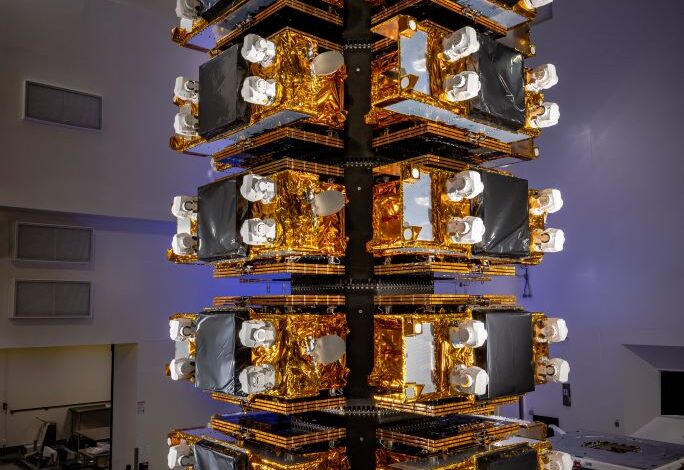
Northrop Grumman has successfully delivered 21 satellites to Vandenberg Space Force Base, California, marking a crucial advancement in the Space Development Agency’s (SDA) Proliferated Warfighter Space Architecture (PWSA). These satellites are part of the Tranche 1 Transport Layer (T1TL) and will enhance warfighter communication capabilities and data transport for the PWSA Tracking Layer. Over the next six months, additional Northrop Grumman-built satellites for the PWSA are scheduled for launch into low Earth orbit (LEO), playing vital roles in missile defense and data transport missions.
As a longstanding leader in military space technology, Northrop Grumman continues to build on its extensive experience with advanced systems like the James Webb Space Telescope and the Arctic Satellite Broadband Mission. The company is leveraging its expertise in multi-orbit, end-to-end systems to produce resilient and proliferated satellite architectures at an accelerated pace, which is essential for modern warfare needs.

Northrop Grumman’s recent delivery of 21 satellites is a step forward in providing secure communications for the warfighter. (Photo Credit: Northrop Grumman)
Innovating for Modern Missions
The PWSA is designed as a modern constellation of satellites tasked with detecting and tracking missiles and ensuring rapid data transmission globally. Northrop Grumman is effectively merging its advanced technological capabilities with commercially developed solutions, enabling high-volume satellite manufacturing that is both cost-effective and resilient in the face of evolving global threats.
Lou Christen, senior director of proliferated systems at Northrop Grumman, stated, “As a systems engineering center of excellence, we are uniquely suited to integrate these satellites into the warfighter architecture that will defend and protect our nation and its allies. We are embedding mission understanding into every phase of development, enabling us to strike the right balance of speed and mission utility to meet the needs of the warfighter.”
Northrop Grumman’s production capabilities are set for significant expansion. Several PWSA contracts are ongoing, each designed to offer incremental enhancements in mission capabilities. The company reports that numerous satellites are currently undergoing final integration and checkouts, supported by an efficient supply chain and a diverse supplier network that strengthens its production capabilities.
Positioned for Future Success
Through collaboration with the SDA, industry partners, and suppliers, Northrop Grumman is creating interoperable solutions that adhere to SDA’s open architecture standards. This alignment fosters seamless integration across satellites, payloads, and ground systems from various developers, ensuring secure and consistent data flow across multiple domains.
Keith Matthews, T1TL program manager at Northrop Grumman, noted, “Our expertise in developing advanced systems is driving unprecedented scalability in production. We’re utilizing part of Northrop Grumman’s 7-million square feet of manufacturing space specifically dedicated to space programs, equipped with advanced manufacturing systems and AI, to efficiently support the evolving production demands of our PWSA programs.”
With the delivery of these satellites, Northrop Grumman not only accelerates the PWSA rollout but also sets new benchmarks for resilient and scalable space architectures, providing direct benefits to the warfighter. As the constellation expands, Northrop Grumman remains steadfast in its commitment to innovation and collaboration, ensuring the United States sustains its strategic advantage in proliferated LEO operations.
Learn more about Northrop Grumman’s acceleration of satellite production for low Earth orbit.
Source: Northrop Grumman (2026-09-28T13:34:00Z)