

Additive Acceleration: How Northrop Grumman Is Scaling Strategic Manufacturing Capability
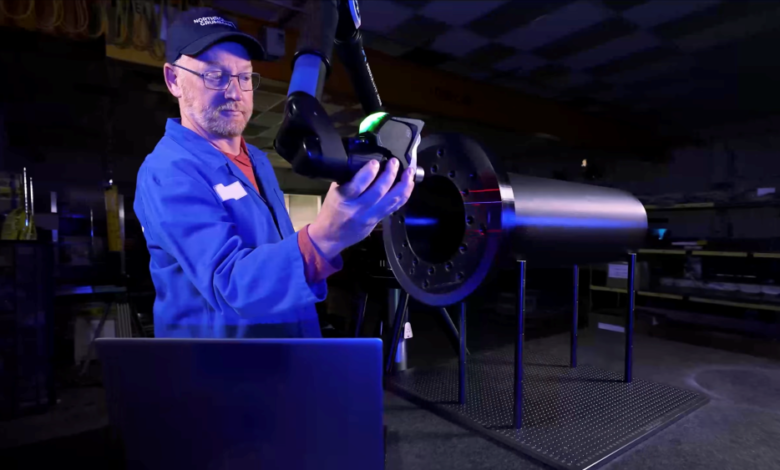
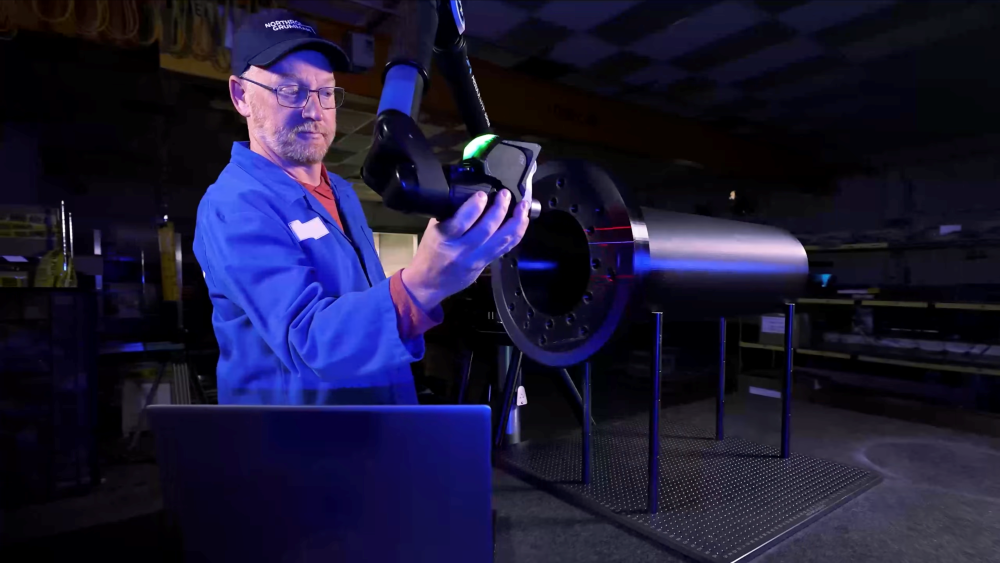 An engineer uses a high-precision inspection system to verify the quality of a large additively manufactured component used in the production of a large solid rocket motor. (Photo Credit: Northrop Grumman)
The process of construction is just as crucial as the end product that emerges.
In today’s environment characterized by heightened demand, supply chain challenges, and swiftly changing threats, the capacity to produce essential systems at scale, with speed, and at a cost-effective rate has become an essential military advantage.
Northrop Grumman is strategically implementing additive manufacturing (AM), commonly known as 3D printing, throughout its facilities. This technique involves constructing components layer by layer rather than machining them from solid blocks of material. Engineers are leveraging a variety of advanced materials, ranging from economical plastics to high-performance metals like titanium, and utilizing industrial-grade 3D printing technologies to rapidly and efficiently produce durable and lightweight aerospace components.
As Northrop Grumman convenes the America Makes Technical Review & Exchange this week, a platform for collaboration between government, industry, and academia, several significant initiatives are demonstrating the transition of AM from mere prototypes to large-scale production:
- Propulsion Tanks: Reducing Lead Times While Ensuring Reliability
Every satellite, spacecraft, and space vehicle relies on propulsion tanks to store critical fuel for mission operations. Northrop Grumman has produced over 7,000 propulsion tanks for national security, commercial, and civil space applications, with zero failures in orbit. Leveraging over sixty years of experience and leadership in AM, the company is now producing 3D-printed tanks that cut lead times by as much as 50% to adapt swiftly to customer demands. - Aircraft Sustainment: Utilizing Additive Manufacturing for Operational Readiness
With over 35 years of experience, Northrop Grumman is applying AM in aviation for sustainment and modernization of platforms like the B-2, facilitating the rapid and high-quality replacement of unique, hard-to-source, or obsolete components. This innovation minimizes supply chain disruptions, prolongs the operational lifespan of aircraft, and ensures that vital capabilities remain available for military personnel. - Space Vehicle Thrusters: Boosting Supply to Meet Demanding Needs
Northrop Grumman is improving its small monopropellant thrusters, essential for satellite maneuvering, by employing AM technologies. As the demand for agile and resilient spacecraft rises, AM helps reduce part counts and assembly labor, streamline production processes, and tailor thruster designs for varying mission requirements, thereby enhancing affordability and delivery timelines. - Solid Rocket Motors: Driving Innovation for Future Capabilities
The Solid Motor Annual Rocket Technology Demonstrator (SMART Demo), initiated in 2023, is pioneering solid rocket motor production by integrating AM and other innovative methodologies throughout the design and manufacturing phases. To date, the project has delivered four new motors and plans to conduct its next test in December. It utilizes AM for tooling and primary hardware components, enabling faster production cycles while lowering costs. - CERAPRINT™ Silicon Carbide: Advancing Technology for Extreme Conditions
Silicon Carbide (SiC) is optimized for use in demanding environments, making it ideal for structures like precision mirrors, optical benches, and high-temperature electronics. Building on over two decades of proven SiC innovations, Northrop Grumman’s Adaptive Optics Xinetics CERAPRINT SiC offers outstanding rigidity and thermal stability. AM allows for lightweight, intricate geometries not achievable with traditional methods, all while ensuring high optical quality. Demonstrated isotropic properties and minimal porosity make CERAPRINT SiC a trusted choice for complex optical and structural applications essential for national security missions.
The implementation of additive manufacturing has transitioned from a niche technology to an integral aspect of Northrop Grumman’s extensive aerospace and defense capabilities. By amplifying AM across advanced material applications and stringent industry standards, Northrop Grumman is establishing a manufacturing framework designed to respond more effectively to the evolving needs of its customers and our armed forces.
Source: Northrop Grumman (2026-10-29T16:58:00Z)