


How smart yards are reshaping shipbuilding | Hanwha
Shipbuilding underpins global trade, energy supply chains, and national security, yet the industry faces a widening skills gap as experienced workers retire faster than they can be replaced.
At its Geoje shipyard, Hanwha Ocean is recording the techniques of veteran welders and using that data to train AI systems that work alongside them. AI now assists with 67% of indoor welding there, and the company is targeting 100% by 2030, supported by robotics and a real-time Digital Production Center.
Through Hanwha Philly Shipyard, Hanwha Ocean is transferring smart yard technologies from Korea to the United States, contributing to a more resilient global shipbuilding industry.
More than 80% of world trade travels by sea. Energy commodities, food, and industrial raw materials all move between continents aboard ships, making shipbuilding a strategic sector that underpins global trade, energy supply chains, and national security. Building a single ship involves tens of thousands of processes, and turning a design into a finished vessel still relies on skills honed over years of experience.
This expertise is now under pressure. South Korea’s shipyards employ around 125,000 people, well below the roughly 200,000 employed at their 2014 peak, according to the Korea Offshore & Shipbuilding Association. Despite an aging workforce and challenges in attracting new skilled workers, companies are expanding training programs and seeking innovative ways to attract younger talent. Shipbuilders are evolving towards smart yards, where AI, robotics, and digital production management help to capture expertise and scale it across operations.
The challenge of shipbuilding is exemplified by large LNG carriers, which can measure about 300 meters in length, equivalent to three football fields. These vessels require hundreds of steel blocks, which are fabricated separately and then assembled. Each weld is critical, as even slight imperfections can compromise the ship’s integrity when facing harsh sea conditions. Historically, correct welding has depended on the intuition of skilled labor, making this knowledge difficult to replace.
Hanwha Ocean’s smart yard initiative aims to preserve this expertise by documenting the workflows of veteran welders and training AI systems to replicate them on the shop floor. AI assistance has currently reached 67% for indoor welding at its Geoje shipyard, with ambitions for full welding automation and 50% AI adoption in surface preparation and painting by 2030.
As technologies advance, the roles of workers are shifting rather than disappearing. Robots are increasingly tasked with high-risk jobs involving heat, sparks, and cramped spaces, allowing skilled workers to transition into supervisory roles where they monitor multiple robotic systems and ensure quality standards.
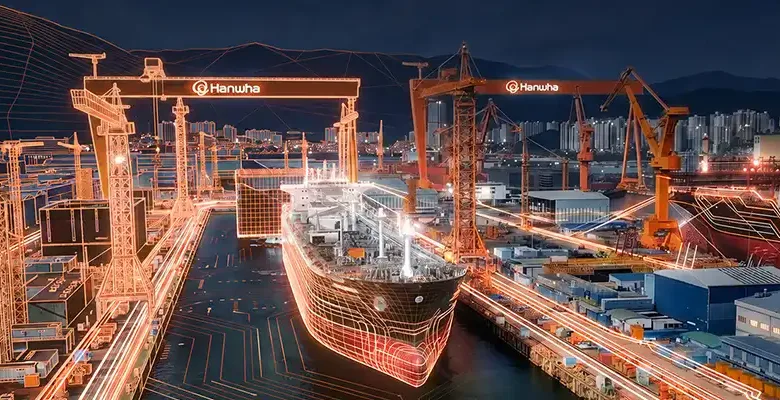
Hanwha Ocean’s Geoje shipyard spans approximately 5 square kilometers (1,225 acres), where numerous ships are under construction simultaneously. Each ship consists of hundreds of blocks that must undergo a sequence of outfitting, painting, and installation. To maintain efficiency, knowing the exact location and progress of each block is critical.
In response, Hanwha Ocean has developed Korea’s first Digital Production Center for shipbuilding, which provides real-time oversight of the entire yard. Similar to an airport control tower, this center allows managers to oversee operations without physically inspecting each area. Drones and IoT sensors update block locations every 30 minutes, and simulations can predict disruptions, facilitating timely adjustments.
This technological approach also aids operations at sea. The Smart Sea Trial Center enables engineers onshore to evaluate a vessel’s performance during sea trials and troubleshoot remotely, utilizing data to improve future designs and maintain timely deliveries.
Hanwha’s innovative practices extend beyond Korea. A Deloitte report on U.S. shipbuilding identifies smart manufacturing, standardized designs, interoperable data, and robotics as essential for enhancing American shipyards’ productivity amidst workforce limitations. Hanwha Philly Shipyard, integrated into Hanwha since 2024, stands as the first yard outside Korea to implement these advanced technologies. Plans for expansion include increasing the yard’s annual output to 20 vessels, adding two dry docks, three piers, and a new block production facility, alongside the integration of automation and smart systems.
Digital transformation is in progress, with the implementation of enterprise resource planning (ERP) and production management systems initiated in November 2024. Full deployment is projected for November 2026, aiming to triple the yard’s level of digitization. In 2026, welding robots proven in Korea are set to be introduced, furthering the technology transfer.
This overarching shift in shipbuilding is about more than just new equipment; it is about redefining how skills are preserved and disseminated. The knowledge of veteran workers is becoming codified into data that orchestrates yard operations. Automation is not a means to replace craftsmanship, but rather an opportunity to document and amplify the insights of skilled labor, allowing experienced workers to focus on supervisory tasks while automated systems handle the more hazardous aspects of the work. Hanwha Ocean is fostering a more competitive global shipbuilding industry and a sustainable future for maritime manufacturing through these advancements.