


New vibration test facility for Rheinmetall in Telford
Telford, UK – 17 September – Rheinmetall UK has enhanced the United Kingdom’s sovereign defense engineering capabilities through a substantial investment in a new Vibration Test Facility (VTF) at its Telford location.
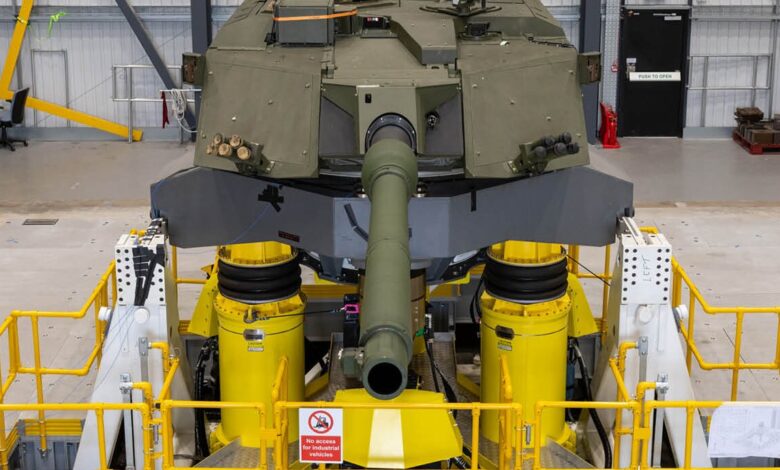
Currently supporting the development of the Challenger 3, the British Army’s next-generation Main Battle Tank, this facility will allow engineers to test and validate intricate defense platforms and systems within the UK. This development aims to decrease dependency on prolonged physical trials and offers rapid, thorough evidence to guide engineering decisions.
The investment not only brings advanced testing infrastructure but also integrates specialized engineering expertise and high-value skills within Telford, thereby bolstering the UK’s defense industrial base and enhancing capabilities for both current and future defense programs.
The VTF is capable of simulating the challenging vibrations and movements that military vehicles and equipment encounter in real-world operations. Engineers can utilize actual operational data to replicate these conditions in a controlled setting, permitting them to evaluate reliability, pinpoint potential problems, and gain insights into how platforms and their systems are likely to perform over extensive service durations.
For the Challenger 3, this facility offers an additional avenue for understanding how the vehicle and its systems react under demanding operational circumstances. It synergizes with physical trials, modeling, and other engineering analyses, thus aiding in the accumulation of evidence required to validate the reliability and performance of the platform.
Crucially, the VTF is designed as a sustainable UK engineering capability, rather than intended for a single initiative. Its adaptability and scale enable it to support future defense platforms and technologies, in addition to applications across sectors such as aerospace, automotive, rail, energy, and civil engineering.
With the capacity to accommodate structures and assemblies weighing up to 40 tonnes, the facility can replicate complex movements, including vertical motion, pitch, and roll. This functionality empowers engineers to simulate demanding operational conditions and conduct accelerated durability and reliability testing, minimizing the reliance on prolonged physical trials.
Rob Hunter, Vibration Test Manager, noted: “The VTF provides our engineers with a powerful new means to comprehend complex platforms. We can recreate challenging operational conditions, evaluate equipment responses, and leverage that data for more informed engineering decisions.”
“While Challenger 3 is a significant application, we have purposefully designed this capability with future applications in mind. Its versatility allows us to adapt to various engineering challenges, supporting upcoming programs and technologies while preserving critical engineering knowledge and skills domestically in the UK.”
The facility is backed by a team of specialized engineers and technicians proficient in mechanical and electrical engineering, testing, instrumentation, software, and data analysis. It will also create opportunities to cultivate high-value, transferable skills among apprentices and develop the next generation of British engineers and technicians.
By merging advanced infrastructure with British engineering expertise and skilled personnel, the VTF exemplifies Rheinmetall UK’s ongoing commitment to enhancing the sovereign defense capabilities of the UK.
As the UK fortifies its defense industrial foundation, investments like the VTF are pivotal for developing the domestic skills, infrastructure, and industrial capacity necessary to create, validate, and maintain increasingly sophisticated defense equipment.
Thus, the VTF represents far more than just a new piece of testing infrastructure; it is a long-term investment in the human resources, technology, and sovereign engineering capability essential for supporting the Challenger 3, future UK defense programs, and the innovations of tomorrow.