



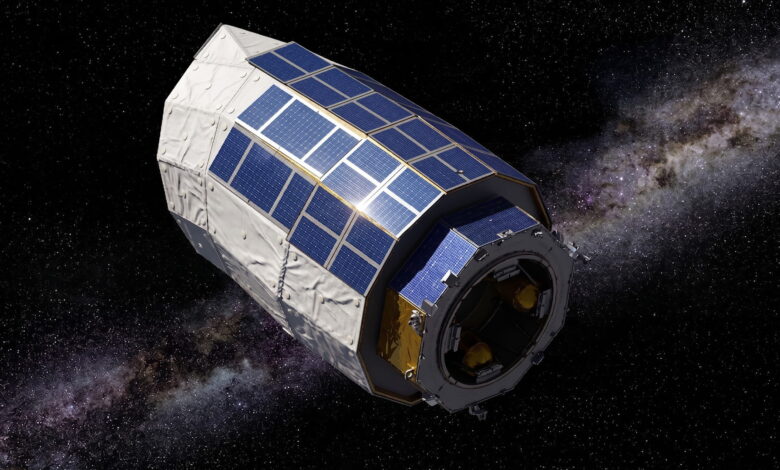
RTX’s Raytheon developing large-aperture telescope for rapid observations and precision astrophysics
Lazuli Space Observatory adapts a proven telescope design for groundbreaking deep space science platform
EL SEGUNDO, Calif., June 30, 2026 — Raytheon, a business unit of RTX (NYSE: RTX), is spearheading the development of a large-aperture telescope for the Lazuli Space Observatory, which is part of The Eric and Wendy Schmidt Observatory System at Schmidt Sciences. The project leverages Raytheon’s expertise in adaptive telescope architectures, ultra-lightweight materials, and digital engineering to deliver the largest unobscured aperture ever launched on a commercial platform.
The new telescope features a 3.1-meter off-axis aperture, which enhances sharpness, sensitivity, and operational flexibility. This marks the first visible-light telescope constructed with advanced materials capable of maintaining stability without lengthy temperature adjustments, enabling it to collect high-quality data quickly and support both urgent observations and prolonged monitoring activities.
“Raytheon is deploying proven technology that enhances production speed, reliability, and adaptability for the Lazuli Space Observatory,” remarked Jeff McCall, vice president of Mission Solutions & Payloads at Raytheon. “Our large-aperture systems provide exceptional capabilities suited for diverse missions in challenging space environments.”
The telescope incorporates auto alignment technology, which has been validated through digital twin simulations and sophisticated optical engineering practices. This system ensures high-quality scientific data is consistently delivered throughout its operational orbit, through continuous optimization of optical performance without requiring manual adjustments. Such on-orbit tuning will significantly enhance scientific observations of distant planets, dynamic astrophysical events, distant cosmic signals, and cosmic evolution.
Raytheon has successfully completed a rapid preliminary design review, with production of the telescope already underway and an anticipated delivery in 2028.
About Raytheon
Raytheon, part of RTX, stands as a leading provider of defense solutions dedicated to assisting the U.S. government, its allies, and partners in safeguarding national sovereignty and security. For over a century, Raytheon has pioneered new technologies and enhanced existing capabilities across domains such as integrated air and missile defense, advanced sensors and radars, missile systems, and space initiatives.
About RTX
Headquartered in Arlington, Virginia, RTX employs over 180,000 people globally, relentlessly pushing the boundaries of technology and science to enhance connectivity and protection worldwide. With industry-leading capacities, RTX advances aviation and develops integrated defense systems that ensure operational efficacy and address critical global challenges. The company is projected to generate sales exceeding $88 billion in 2025.
For inquiries or to schedule an interview, please contact [email protected]
About Schmidt Sciences
Schmidt Sciences is a nonprofit established in 2024 by Eric and Wendy Schmidt with a mission to accelerate scientific breakthroughs using advanced tools for a sustainable planet. It emphasizes research in transformative fields, including astrophysics, AI, advanced computing, and climate science, and supports researchers through its science systems program.
For questions regarding the Lazuli Space Telescope or the Schmidt Observatory System, please contact [email protected].
SOURCE RTX
Source: RTX (Raytheon) (2026-06-30 12:00:00)