


Roman Space Telescope Will Survey a Century of Cosmos in Weeks: L3Harris Technology Makes It Possible
In just one month, NASA is set to launch the revolutionary Nancy Grace Roman Space Telescope, one of the most ambitious space observatories ever constructed. This telescope, named after NASA’s first chief of astronomy, will survey the cosmos at a staggering pace—1,000 times faster than the Hubble Space Telescope. Over its first five years, it aims to discover more than 100,000 distant planets, tens of billions of stars, and billions of galaxies.
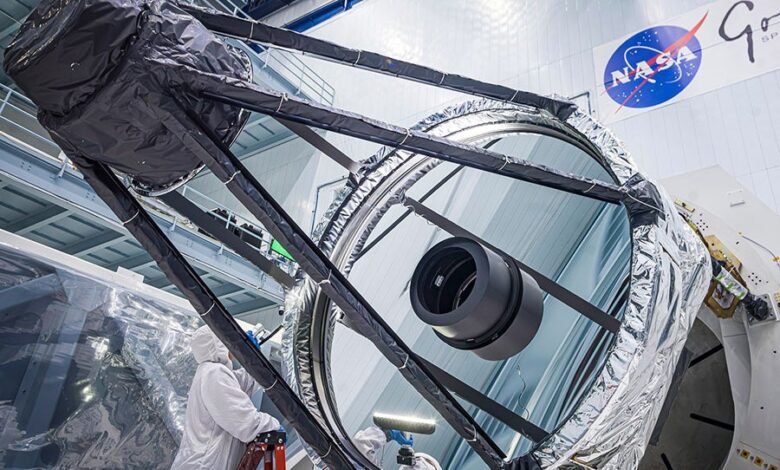
L3Harris Technologies has been instrumental in the success of this endeavor, responsible for designing and constructing the optical telescope assembly, which serves as the primary vision for the Roman mission. Additionally, they have developed essential communication systems, guidance sensors, and electronic components that will operate flawlessly for years in the inhospitable environment of space.
Engineering for the Extreme
Operating at the second Lagrange point (L2), approximately 1 million miles from Earth, the Roman Space Telescope will face extreme conditions. This location, where the gravitational forces of the Earth and Sun balance, exposes the telescope to harsh temperatures and detrimental radiation. For over a decade, L3Harris has collaborated with NASA’s Goddard Space Flight Center to create technology that can endure these rigorous conditions.
Standing on the Shoulders of Giants
L3Harris boasts a remarkable legacy in space exploration that spans more than 60 years. The company was integral to the assembly and testing of the James Webb Space Telescope, which operates in the same L2 region that Roman will occupy. Their systems have been deployed in notable missions, including the Mars Perseverance and Curiosity rovers, as well as providing critical support for the GPS satellite constellation and the International Space Station through the Mission Astronaut Communication System for NASA’s Artemis II mission.
The Roman mission symbolizes decades of advancements in space technology, as every component is designed to exceed the highest expectations. With its exceptional speed and expansive field of view, the telescope is poised to enhance our understanding of dark energy— the elusive force driving the universe’s expansion— and to uncover exoplanets on an unprecedented scale.
Three Surveys to Rewrite Astronomy Textbooks
Roman is set to conduct three groundbreaking surveys that promise to reshape our comprehension of the universe. The first will probe the dense galactic center of the Milky Way, searching for a hundred thousand planets orbiting other stars. The second will survey approximately 12% of the sky in less than 18 months to measure the universe’s expansion rate and map dark matter with exceptional accuracy. The third survey will observe supernova explosions dating back to eight billion years, providing insights into how the universe has evolved and the role of dark energy in that evolution.
This mission holds the potential to identify worlds capable of sustaining life, with its coronagraph instrument designed to image exoplanets by obscuring their host stars’ luminosity. This technology is vital for advancing toward NASA’s Habitable Worlds Observatory. The coronagraph serves a dual purpose as both a technology demonstrator and a scientific instrument, linking current capabilities with the transformative potential of future observations. These advancements mark significant progress in humanity’s quest to unravel the complexity, composition, and destiny of the universe.
A Legacy Mission for Future Generations
The launch day represents both a celebration and a new beginning for the engineers, technicians, and scientists at L3Harris who have devoted years to this program. They have thoroughly tested each component, simulated various scenarios, and prepared for countless contingencies. Now, their technology is set to venture into space to explore fundamental questions about dark matter, dark energy, and our cosmic position.
Space exploration pushes the limits of human knowledge and capability, encouraging the coming generations of scientists and engineers. The Roman mission stands as a testament to what can be achieved when ambitious goals align with engineering excellence, showcasing that there are no bounds to human achievement.
The Nancy Grace Roman Space Telescope is destined to revolutionize our understanding of the universe, a transformation that is made possible by L3Harris technology.
Source: L3Harris (2026-08-03)