

In May 2026, when a rare hantavirus outbreak affected the remote island of Tristan da Cunha, UK troops and the Airbus A400M were prepared for action. This critical mission highlighted the essential role the A400M plays within the Royal Air Force (RAF).
Tristan da Cunha, recognized as the most remote inhabited island on Earth, is located in the South Atlantic Ocean. With a population of approximately 220 people, this British overseas territory lies nearly 10,000 kilometers from the United Kingdom, embodying a beautiful isolation.
During the early days of May 2026, the island became the focus of an urgent operation when a local resident was suspected of contracting hantavirus after arriving from the cruise ship MV Hondius. As the island’s hospital faced dwindling supplies of medical oxygen, rapid action was imperative. Given the absence of an airstrip, airborne intervention became the only feasible response.

Preparing the A400M
RAF Brize Norton promptly initiated preparations for a long-range mission with the Airbus A400M Atlas. The flight plan involved a 6,788-kilometer journey south to Ascension Island, followed by an additional 3,000 kilometers to Tristan da Cunha. The operation relied heavily on the Airbus A330 MRTT Voyager, which provided in-flight refueling to expedite the mission.
“Two key challenges were evident: the geographic distance from Brize and the island’s challenging topography and weather. Surrounded by treacherous seas, successful execution was uncertain.”
— Group Captain Andy, Commander Air Wing Air Mobility Force
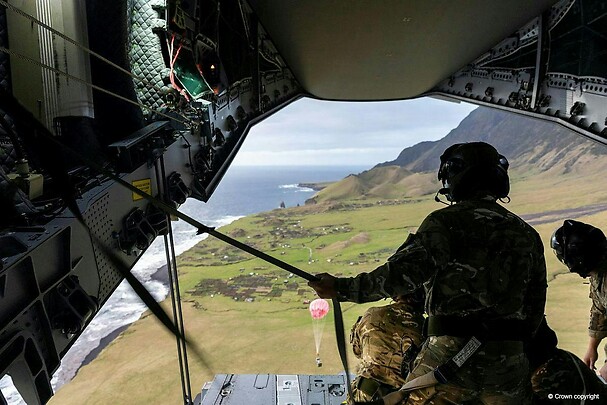
The mission involved airdropping essential oxygen and medical supplies in stages while an expert team parachuted onto the island. This team comprised eight personnel: six paratroopers and two military clinicians — an RAF anaesthetist and an Army nurse from 16 Medical Regiment — to assist the local medical staff. It marked a historic moment, as the UK military had never before parachuted in medical personnel to deliver emergency aid.
Executing the jump presented significant challenges due to the island’s notorious weather, characterized by wind speeds often exceeding 25 mph. Despite these obstacles, the crew’s precision during the high-stakes insertion was commended. Wing Commander Toby reflected on the experience: “Standing on the ramp was obviously nerve-wracking, but I had every faith in the pathfinders that were jumping us in.”
Always ready to deliver
The Rafael’s emergency response to Tristan da Cunha stands as a compelling entry in the aircraft’s growing list of significant deployments. The A400M has played pivotal roles in past operations, including major evacuation efforts in Kabul during Operation Pitting in 2021 and the evacuation of British nationals from Sudan two years later.

The A400M also serves as a crucial asset in global disaster response efforts. With a payload capacity of up to 37 tonnes and the ability to land on short, unpaved runways, it has facilitated successful relief operations in response to hurricanes in the Caribbean and earthquakes in Syria, Turkey, and Morocco in 2023.
In July 2023, the A400M’s capabilities were rigorously tested ahead of Exercise Mobility Guardian. A RAF A400M managed a record-breaking non-stop flight from RAF Brize Norton to Guam, supported by three in-flight refuelings from A330 MRTTs, completing a daunting journey exceeding 20 hours.
More to come
Since entering service with the RAF in November 2014, the A400M Atlas has established itself as a backbone of military logistics, adept at performing complex tactical operations such as precision paratrooper insertions and intricate air drops. Currently, the RAF operates a fleet of 22 A400M aircraft.
Looking ahead, the A400M is set to evolve further with new capabilities, such as potentially deploying drones into combat. Development is ongoing for a “mother ship capability,” alongside trials showcasing its potential as a firefighting aircraft, capable of discharging up to 20,000 liters of water or retardant.
In partnership with Airbus, the RAF has been dedicated to ensuring the A400M fleet remains mission-ready for present and future demands. Although the aircraft has already served the UK for twelve years, many more milestones are anticipated as its story continues for decades to come.
Source: Airbus Defence and Space (2026-07-20)