

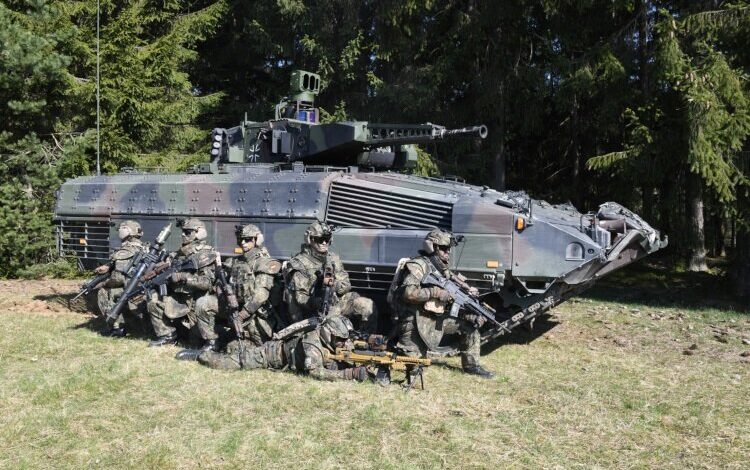
For 12 months, the Bundeswehr has assumed leadership of the Very High Joint Readiness Task Force (VJTF), the so-called “NATO spearhead.” In the event of a deployment, German soldiers will find themselves on the front lines. Rheinmetall, as a partner of the Bundeswehr, is committed to meeting the heightened requirements of the VJTF and ensuring the protection of the soldiers.
NATO mandates that the VJTF must be operational within 48 to 72 hours, comprising at least 5,000 soldiers from the army, air force, navy, and special forces, all on standby. The leadership of this rapid-response force rotates annually among NATO nations, with Germany, France, Great Britain, Italy, Poland, and Spain all expressing willingness to participate. In 2023, Germany will lead the VJTF, contributing up to 2,700 soldiers, while Rheinmetall Defence will play a significant role in the continuous supply of necessary materials.
The crisis response force
The VJTF is the core of NATO’s Response Force (NRF) and is integrated into the Readiness Action Plan (RAP), established to enhance NATO’s response capacity. Initiated in 2014/2015, this response force was a direct result of the annexation of Crimea by Russia, underscoring the need for quicker mobilization to protect the Baltic states.
Germany’s responsibility as a framework nation
Germany joined NATO in 1954 through the Paris Treaties and has been a reliable partner since 1955, participating in international military operations and defense initiatives. During the Cold War, NATO units were stationed in Germany to ensure defense, and now, Germany is once again stepping into a crucial role as the leader of the VJTF.
Decisions regarding operations are made collectively at the political level by NATO member countries through unanimous votes, followed by decisions from the Bundestag regarding Germany’s participation.
The response times of the VJTF
The VJTF operates under a rotation principle divided into three phases:
- Stand-up phase: 45 days to achieve operational readiness
- Stand-by phase: 2 to 7 days to operational readiness
- Stand-down phase: 30 days to operational readiness
In emergencies, NATO is thus able to deploy three multinational brigades within 2 to 45 days. Starting in 2020, Poland will take on the stand-by phase while Germany will enter the stand-down phase, enhancing NATO’s operational readiness.
VJTF and the Bundeswehr
In recent times, the Bundeswehr has faced bottlenecks regarding both personnel and equipment. As the framework nation leading the VJTF in 2023, significant improvements are necessary. The large NATO exercise “Trident Juncture” in 2018, which involved 50,000 soldiers from 31 nations defending alliance territories, marked a successful logistical challenge and provided crucial certification for the VJTF despite limited resources at the time. The German Ministry of Defence has expressed satisfaction with the outcomes, which were aimed at identifying weaknesses in current operations.
The brigades will commit to the VJTF for a three-year period, which represents a substantial commitment as they will not be available for other missions during this time.
Rheinmetall delivers to the Bundeswehr
Rheinmetall plays a pivotal role as the supplier for the VJTF 2023, particularly during its stand-by phase.
“We have understood the precise requirements of the Bundeswehr. Now we have an obligation to act. The armoured infantry officer system will be the material spearhead of the German army for VJTF. Ultimately, we will have to be assessed in terms of our delivery time, quality, and adherence to budget. If we keep to our promise, we will create the basis for the Bundeswehr’s success. That is entrepreneurial responsibility because our only success is if the Bundeswehr succeeds.”
Christoph Müller
Head of Program Organisation for Germany
Rheinmetall products for VJTF
As part of its contributions, Rheinmetall is delivering several key systems to equip the VJTF, including:
- Puma armoured personnel carrier: Rheinmetall is providing 41 units of the Puma, which will undergo enhancements to meet VJTF design standards, including the integration of advanced systems and improved visibility features.
- Leopard main battle tank: Recognized for its potent combination of firepower, protection, and mobility, the Leopard 2 will be equipped with Rheinmetall’s advanced weapon systems and ammunition.
- Fuchs light wheeled tank: This multifunctional platform remains a backbone of the Bundeswehr, with over 900 units currently in use, offering versatility for various operational roles.
- Marder armoured personnel carrier: Rheinmetall, in collaboration with the Bundeswehr, is ensuring the Marder’s continued relevance by upgrading its capabilities to meet modern battlefield demands.
- Unprotected transport vehicle (UTV): The HX2 family of trucks will provide essential logistical support, with 2,271 vehicles anticipated for delivery under a framework agreement.
- Live ammunition: Rheinmetall is the primary supplier of live ammunition for the Bundeswehr, ensuring they have modern, effective munitions for upcoming VJTF missions.
Through these efforts, Rheinmetall remains committed to equipping the Bundeswehr effectively for the challenges ahead, particularly as they lead the VJTF into 2023.