


The Invisible War Has a New Architecture
The electromagnetic spectrum operates quietly, free of flags or gunfire, yet it remains a pivotal battlefield in modern conflict—the first domain engaged and the last surrendered. Control over this spectrum equates to control over all other military domains.
Patrick Creighton, Vice President and General Manager of Electronic Warfare at L3Harris, offers his insights from years of navigating this invisible conflict. He highlights the evolving nature of threats, which are becoming increasingly rapid and better resourced, rendering outdated single-function electronic warfare (EW) systems inadequate.
“EW is necessary in just about every defensive and offensive system being produced today,” Creighton states. “To ensure survivability. To ensure effectiveness.”
L3Harris is not simply developing enhanced systems; they are innovating a comprehensive architecture designed to scale, adapt, and connect across various domains, platforms, and partnerships.
The Commercial Revolution
Traditionally, advancements in capability were tied to escalating costs. Complex hardware for comprehensive EW operations was prohibitively expensive and heavy, limiting cutting-edge solutions to a select few well-funded initiatives and larger platforms.
However, the commercial electronics market is reshaping this dynamic.
“Rapid advancements in the commercial marketplace are making increasingly capable hardware available at lower cost, enabling us to deliver advanced software-based capabilities on top of that hardware far more affordably,” Creighton explains.
This transformation allows for new and improved systems deployable on a diverse array of platforms, including unmanned systems, rotary-wing aircraft, ground vehicles, and other expendable solutions.
Build Your System: The Modular EW Portfolio
L3Harris has introduced a modular EW portfolio, designed with flexibility in mind. Military operators can select their preferred form factor, then choose their software-defined radios and commercial off-the-shelf hardware to define frequency band coverage.
The distinguishing feature lies in an innovative middleware layer applied across this portfolio.
“We are applying an open architecture middleware layer across all of these products,” Creighton states, “not just on our modular EW portfolio, but across many of the products we’re building today.”
This architecture allows for capabilities, or “skills,” to be integrated into the system—either developed by L3Harris or sourced from third parties. These skills can be updated, replaced, or reconfigured in the field, ensuring that the system is versatile rather than confined to a single function.
“These are no longer single-solution capabilities but genuinely multifunctional systems,” Creighton remarks. “A single system can be adapted for defensive operations, offensive missions, or intelligence collection.”
DiSCO™: The System That Ties It All Together
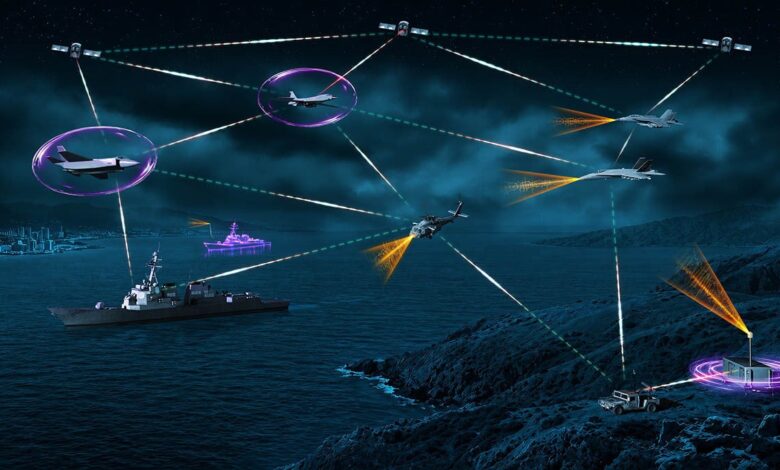
As modular systems evolve, coordinating multiple distributed reconfigurable EW payloads across various platforms and domains becomes crucial. This challenge is addressed by Distributed Spectrum Collaboration Operations (DiSCO).
DiSCO serves as L3Harris’ enterprise-level electromagnetic battle management architecture. Developed in collaboration with leading cloud providers, it integrates battlefield sensors, data links, and communication methods into a cohesive EW network, utilizing artificial intelligence and machine learning to expedite signal identification from months to mere minutes.
“As modular, disparate systems continue to proliferate, an electromagnetic battle management system becomes essential for coordinating non-kinetic sensors and effectors,” Creighton explains. “This is where our DiSCO ecosystem comes in.”
Constructed on open standards and already validated with third-party software, DiSCO actively avoids vendor lock-in, ensuring adaptability and integration flexibility.
Source: L3Harris (2026-09-16)