


One Year of NTS-3: Delivering the Future of Resilient Positioning, Navigation and Timing
As a groundbreaking pathfinder mission, NTS-3 showcases the advantages of a fully reprogrammable space architecture designed to counter adversaries’ escalating capabilities to jam, spoof, and deny GPS.
Developed by L3Harris Technologies in collaboration with the Air Force Research Laboratory and Space Systems Command, NTS-3 aims to assess next-generation concepts across space, ground, and user segments. Over the past year, it has successfully demonstrated resilient, mission-relevant capabilities that strengthen the position, navigation and timing (PNT) enterprise, showcasing how future systems can assure performance in increasingly contested environments.
NTS-3 has effectively demonstrated high power signals, agile acquisition aids, flexible navigation message formats, and alternate signals to expand mission utility. These achievements validate expectations set for 2025 and offer new insights into how these technologies can scale within operational architectures.
The system implemented updates continuously during integration, on the launch pad, and in orbit, enhancing capabilities, adjusting configurations, and improving performance without service interruptions. The team showcased rapid, on-orbit software adaptability to address emerging electronic warfare threats, resulting in a modular, software-defined satellite navigation (SATNAV) architecture.
“NTS-3 represents a fundamental shift in how the industry thinks about satellite navigation – not as a fixed capability but as an evolving and adaptable enterprise,” stated Nate Krejca, General Manager of Mission Critical RF at L3Harris. “What we’ve proven over the past year changes the conversation about what’s possible for the future of PNT.”
This level of adaptability is made possible by L3Harris’s modular payload design and software-defined processing framework, which was delivered on a notably accelerated schedule. Completed in just 44 months, NTS-3’s fully integrated spacecraft was developed approximately three times faster than similar programs.
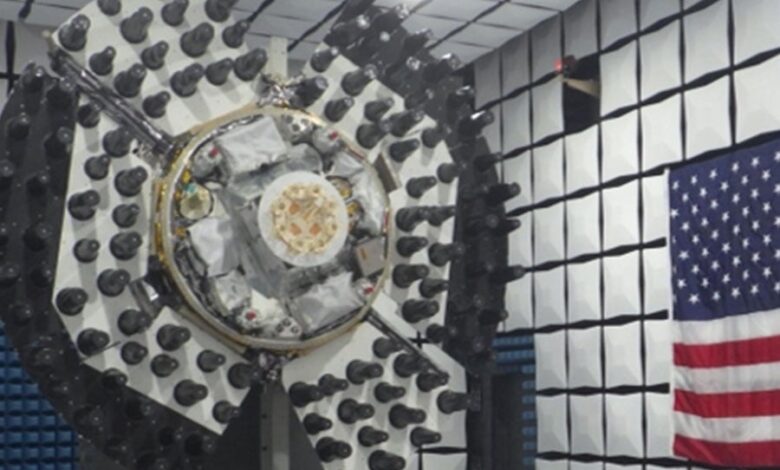
The software-defined payload, modular processor framework, and flexible phased-array antenna aid in informing next-generation architectures while enabling increased resiliency. These elements illustrate how future space-based PNT systems can deliver tailored effects, support a variety of mission requirements, and incorporate rapid updates across the satellite’s lifecycle at lower costs.
Insights gained from NTS-3 are contributing to multiple next-generation initiatives, including resilient multi-orbit architectures. These lessons inform how future systems will ensure assured timing and navigation for warfighters and allies while providing decision-makers with comprehensive knowledge on how flexible SATNAV capabilities can mitigate emerging operational risks.
NTS-3’s proven reprogrammability and modular design support a broader Department of the Air Force investigation into hybrid PNT, proliferated constellations, and multi-source navigation frameworks across all orbital regimes.
One year post-launch, NTS-3 emerges as a pivotal demonstration of the future of SATNAV. Marking the first enterprise navigation experiment in fifty years, it underscores that adaptable, reprogrammable, mission-tailored PNT is not merely attainable but crucial. NTS-3 paves the way for resilient architectures that will protect critical timing and navigation services for decades to come.
Source: L3Harris (2026-09-14)